Advertisements
Advertisements
प्रश्न
The breakdown in a reverse biased p–n junction diode is more likely to occur due to ______.
- large velocity of the minority charge carriers if the doping concentration is small.
- large velocity of the minority charge carriers if the doping concentration is large.
- strong electric field in a depletion region if the doping concentration is small.
- strong electric field in the depletion region if the doping concentration is large.
विकल्प
a and d
b and d
c and d
b and c
Advertisements
उत्तर
a and d
Explanation:
Reverse biasing: Positive terminal of the battery is connected to the N-crystal and negative terminal of the battery is connected to P-crystal.
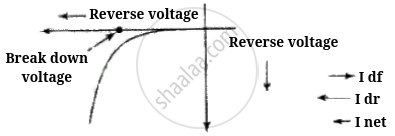
(i) In reverse biasing width of the depletion layer increases
(ii) In reverse biasing resistance offered `R_("Reverse")` = 105 Ω
(iii) Reverse bias supports the potential barrier and no current flows across the junction due to the diffusion of the majority carriers.
(A very small reverse current may exist in the circuit due to the drifting of minority carriers across the junction)
(iv) Break down voltage: Reverse voltage at which break down of semiconductor occurs. For Ge, it is 25 V and for Si, it is 35 V.
So, we conclude that in reverse biasing, ionization takes place because the minority charge carriers will be accelerated due to reverse biasing and striking with atoms which in turn cause secondary electrons and thus more charge carriers.
When doping concentration is large, there will be a large number of ions in the depletion region, which will give rise to a strong electric field.
APPEARS IN
संबंधित प्रश्न
With the help of neat labelled circuit diagram explain the working of half wave rectifier using semiconductor diode. Draw the input and output waveforms.
Plot a graph showing variation of current versus voltage for the material GaAs ?
Show on a graph, the variation of resistivity with temperature for a typical semiconductor.
Why is a zener diode considered as a special purpose semiconductor diode?
The plate current in a diode is 20 mA when the plate voltage is 50 V or 60 V. What will be the current if the plate voltage is 70 V?
Depletion layer in p - n junction diode consists of
The expected energy of the electron at absolute zero is called:-
In a semiconductor diode, the barrier potential offers opposition to only
In the circuit shown in figure, if the diode forward voltage drop is 0.3 V, the voltage difference between A and B is ______.

A Zener of power rating 1 W is to be used as a voltage regulator. If zener has a breakdown of 5 V and it has to regulate voltage which fluctuated between 3 V and 7 V, what should be the value of Rs for safe operation (Figure)?

In the circuit shown in figure, when the input voltage of the base resistance is 10 V, Vbe is zero and Vce is also zero. Find the values of Ib, Ic and β.

Answer the following giving reasons:
A p-n junction diode is damaged by a strong current.
A semiconductor device is connected in series with a battery, an ammeter and a resistor. A current flows in the circuit. If. the polarity of the battery is reversed, the current in the circuit almost becomes zero. The device is a/an ______.
When the p-side and n-side are joined, in which direction do holes diffuse?
What is left behind near the junction, creating a depletion layer?
What opposes further diffusion in the depletion layer?
Which practical effect is associated with reverse bias before breakdown?
