Advertisements
Advertisements
Question
Solve the numerical problem.
Calculate the frequency in MHz of a radio wave of wavelength 250 m. Remember that the speed of all EM waves in a vacuum is 3.0 × 10⁸ m/s.
Advertisements
Solution
Given: λ = 250 m, c = 3 × 10⁸ m/s
To find: Frequency (ν)
Formula: c = νλ
Calculation: From formula,
ν = `"c"/λ=(3xx10^8)/250` = 1.2 × 10⁶ Hz = 1.2 MHz
The frequency of a radio wave is 1.2 MHz.
APPEARS IN
RELATED QUESTIONS
Name the parts of the electromagnetic spectrum which is
used to treat muscular strain.
Write in brief, how these waves can be produced.
To which part of electromagnetic spectrum does a wave of frequency 3 × 10¹³ Hz belong?
Give a reason for the following:
Long-distance radio broadcasts use short-wave bands. Why?
Give a reason for the following:
It is necessary to use satellites for long-distance TV transmission. Why?
State the approximate range of wavelength associated with visible light.
Name the rays or waves of highest frequency .
Is it possible that in a Coolidge tube characteristic Lα X-rays are emitted but not Kα X-rays?
Why is exposure to X-rays injurious to health but not exposure to visible light, when both are electromagnetic waves?
One of the following wavelengths is absent and the rest are present in the X-rays coming from a Coolidge tube. Which one is the absent wavelength?
The figure shows the intensity-wavelength relations of X-rays coming from two different Coolidge tubes. The solid curve represents the relation for the tube A in which the potential difference between the target and the filament is VA and the atomic number of the target material is ZA. These quantities are VB and ZB for the other tube. Then,
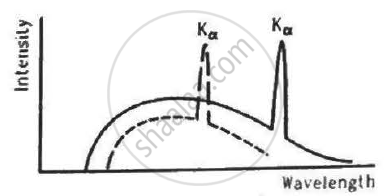
50% of the X-rays coming from a Coolidge tube are able to pass through a 0.1 mm thick aluminium foil. If the potential difference between the target and the filament is increased, the fraction of the X-rays passing through the same foil will be
The electric current in an X-ray tube (from the target to the filament) operating at 40 kV is 10 mA. Assume that on an average, 1% of the total kinetic energy of the electron hitting hte target are converted into X-rays.
(a) What is the total power emitted as X-rays and (b) how much heat is produced in the target every second?
The distance between the cathode (filament) and the target in an X-ray tube is 1.5 m. If the cutoff wavelength is 30 pm, find the electric field between the cathode and the target.
(Use Planck constant h = 6.63 × 10⁻³⁴ Js= 4.14 × 10⁻¹⁵ eVs, speed of light c = 3 × 10⁸ m/s.)
Name the scientist who discovered
X-rays
Name the part of the electromagnetic spectrum which is:
Produced by bombarding a metal target with high electrons.
Name the radiation of the electromagnetic spectrum which is used for the following:
Radar and Give the frequency range.
Name any two electromagnetic waves which have a frequency higher than that of violet light. State one use of each.
Name two sources of infrared radiation.
State two properties of infrared radiations which differ from visible light.
Choose the correct option.
Earth’s atmosphere is richest in
An e.m. wave exerts pressure on the surface on which it is incident. Justify.
A car is moving towards a high cliff. The car driver sounds a horn of frequency f. The reflected sound heard by the driver has a frequency 2f. If v be the velocity of sound, then the velocity of the car, in the same velocity units, will be:
The area to be covered for T.V telecast is doubled then the height of transmitting antenna (T.V tower) will have to be:-
All components of the electromagnetic spectrum in a vacuum have the same ______
Write two uses of the following radiation.
X-rays
Assertion (A): Ultraviolet radiations is scattered more as compared to the microwave radiations.
Reason (R): Wavelength of ultraviolet radiation is more than the wavelength of microwave radiation.
Which relation connects the speed of light in vacuum, frequency, and wavelength?
Which part of the electromagnetic spectrum can the human eye detect?
