Advertisements
Advertisements
प्रश्न
Solve the numerical problem.
Calculate the frequency in MHz of a radio wave of wavelength 250 m. Remember that the speed of all EM waves in a vacuum is 3.0 × 10⁸ m/s.
Advertisements
उत्तर
Given: λ = 250 m, c = 3 × 10⁸ m/s
To find: Frequency (ν)
Formula: c = νλ
Calculation: From formula,
ν = `"c"/λ=(3xx10^8)/250` = 1.2 × 10⁶ Hz = 1.2 MHz
The frequency of a radio wave is 1.2 MHz.
APPEARS IN
संबंधित प्रश्न
Optical and radio telescopes are built on the ground but X-ray astronomy is possible only from satellites orbiting the earth. Why?
Name the electromagnetic radiations used for (a) water purification, and (b) eye surgery.
The wavelength of X-rays is 0.01 Å. Calculate its frequency. State the assumption made, if any.
Name of physical quantity which remains same for microwaves of wavelength 1 mm and UV radiations of 1600 Å in vacuum.
X-ray and visible light travel at the same speed in vacuum. Do they travel at the same speed in glass?
Is it possible that in a Coolidge tube characteristic Lα X-rays are emitted but not Kα X-rays?
Moseley's Law for characteristic X-ray is √v = a(Z − b). Here,
The figure shows the intensity-wavelength relations of X-rays coming from two different Coolidge tubes. The solid curve represents the relation for the tube A in which the potential difference between the target and the filament is VA and the atomic number of the target material is ZA. These quantities are VB and ZB for the other tube. Then,
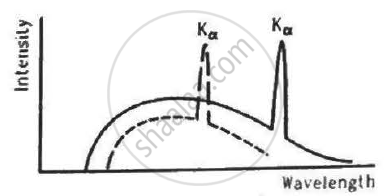
X-ray from a Coolidge tube is incident on a thin aluminium foil. The intensity of the X-ray transmitted by the foil is found to be I0. The heating current is increased to increase the temperature of the filament. The intensity of the X-ray transmitted by the foil will be
(a) zero
(b) < I0
(c) I0
(d) > I0
The potential difference applied to an X-ray tube is increased. As a result, in the emitted radiation,
(a) the intensity increases
(b) the minimum wavelength increases
(c) the intensity remains unchanged
(d) the minimum wavelength decreases.
What potential difference should be applied across an X-ray tube to get X-ray of wavelength not less than 0.10 nm? What is the maximum energy of a photon of this X-ray in joule?
(Use Planck constant h = 6.63 × 10⁻³⁴ Js= 4.14 × 10⁻¹⁵ eVs, speed of light c = 3 × 10⁸ m/s.)
The X-ray coming from a Coolidge tube has a cutoff wavelength of 80 pm. Find the kinetic energy of the electrons hitting the target.
(Use Planck constant h = 6.63 × 10⁻³⁴ Js= 4.14 × 10⁻¹⁵ eVs, speed of light c = 3 × 10⁸ m/s.)
Find the maximum potential difference which may be applied across an X-ray tube with tungsten target without emitting any characteristic K or L X-ray. The energy levels of the tungsten atom with an electron knocked out are as follows.
| Cell containing vacancy | K | L | M |
| Energy in keV | 69.5 | 11.3 | 2.3 |
The wavelengths of Kα and Lα X-rays of a material are 21.3 pm and 141 pm respectively. Find the wavelength of Kβ X-ray of the material.
(Use Planck constant h = 6.63 × 10⁻³⁴ Js= 4.14 × 10⁻¹⁵ eVs, speed of light c = 3 × 10⁸ m/s.)
Name the scientist who discovered Microwaves
Name the radiation of the electromagnetic spectrum which is used for the following:
For taking photographs of the sky during the night and foggy conditions . Give the frequency range
Name any two electromagnetic waves which have a frequency higher than that of violet light. State one use of each.
How will you investigate the existence of the radiation beyond the red and violet extremes of the spectrum?
Calculate the wavelength of a microwave of a frequency of 8.0 GHz.
The frequency of x-rays, y-rays and ultraviolet rays are respectively a, b and c. Then:-
Why does microwave oven heats up a food item containing water molecules most efficiently?
Electromagnetic waves with wavelength
- λ1 is used in satellite communication.
- λ2 is used to kill germs in water purifies.
- λ3 is used to detect leakage of oil in underground pipelines.
- λ4 is used to improve visibility in runways during fog and mist conditions.
- Identify and name the part of electromagnetic spectrum to which these radiations belong.
- Arrange these wavelengths in ascending order of their magnitude.
- Write one more application of each.
In uranium (Z = 92) the K absorption edge is 0.107 Å and the Kα line is 0.126 Å, and the wavelength of the L absorption edge is ______.
What is the speed of radio waves in vacuum?
What is called the invisible spectrum?
Which relation connects the speed of light in vacuum, frequency, and wavelength?
Why can a microwave oven heat food?
Where does infrared radiation lie relative to visible light?
What can result from excess ultraviolet exposure?
