Advertisements
Advertisements
प्रश्न
Characteristic X-rays may be used to identify the element from which they are being emitted. Can continuous X-rays be used for this purpose?
Advertisements
उत्तर
Characteristic X-rays are emitted due to the transitions of electrons among different shells. The wavelength of the X-rays emitted in these transitions have definite value for a particular element. But continuous X-rays are emitted due to the conversion of kinetic energy of an electron into photon, which varies from collision to collision and is independent of material. Hence, continuous X-rays provide no information about the element from which they are being emitted.
APPEARS IN
संबंधित प्रश्न
What role dose infra-red radiation play in physical therapy?
Identify the part of the electromagnetic spectrum which is suitable for radar system used in aircraft navigation.
Name the parts of the electromagnetic spectrum which is
used to treat muscular strain.
Write in brief, how these waves can be produced.
The small ozone layer on top of the stratosphere is crucial for human survival. Why?
What is the range of the wavelength of the following electromagnetic waves?
(a) Ultraviolet
State the approximate range of wavelength associated with the ultraviolet rays.
Name two sources, each of infrared radiations and ultraviolet radiations.
In a Coolidge tube, electrons strike the target and stop inside it. Does the target get more and more negatively charged as time passes?
Why is exposure to X-rays injurious to health but not exposure to visible light, when both are electromagnetic waves?
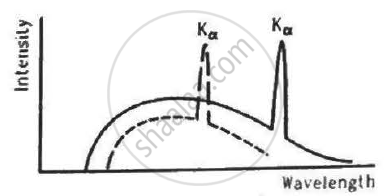
The figure shows the intensity-wavelength relations of X-rays coming from two different Coolidge tubes. The solid curve represents the relation for the tube A in which the potential difference between the target and the filament is VA and the atomic number of the target material is ZA. These quantities are VB and ZB for the other tube. Then,
X-ray incident on a material
(a) exerts a force on it
(b) transfers energy to it
(c) transfers momentum to it
(d) transfers impulse to it.
State two uses of infrared radiations.
Light of wavelength `3500A` is incident on two metals A and B whose work functions are 3.2 eV and 1.9 eV respectively. Which metal will emit photoelectrons?
The frequency of e. m waves which is best suited .to observed of radius 3 × 10⁻⁴ his of the order of
Find the photon energy in units of ev for electromagnetic wave if waves length 40 m. Given h = 6.63 × 10⁻³⁴ J.
If λv, λx and λm Am represents the wavelength of visible light, x-ray and microwaves respectively, then ______.
Identify the electromagnetic wave whose wavelength range is from about 10-12 m to about 10-8 m. Write one use of this.
Which relation connects the speed of light in vacuum, frequency, and wavelength?
Which set lists uses of microwaves?
How are X-rays commonly produced?
