Advertisements
Advertisements
प्रश्न
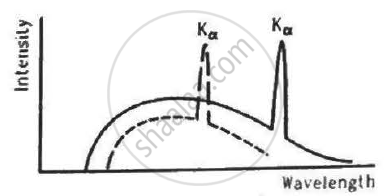
The figure shows the intensity-wavelength relations of X-rays coming from two different Coolidge tubes. The solid curve represents the relation for the tube A in which the potential difference between the target and the filament is VA and the atomic number of the target material is ZA. These quantities are VB and ZB for the other tube. Then,
विकल्प
VA > VB, ZA > ZB
VA > VB, ZA < ZB
VA < VB, ZA > ZB
VA > VB, ZA < ZB
Advertisements
उत्तर
VA > VB, ZA < ZB
It is clear from the figure that the X-ray of tube A has less cutoff wavelength than the X-ray of tube B.
`therefore lambda_A < lambda_B`
Using Moseley's Law,
`Z_A < Z_B`
`lambda ∝ 1/V` , where V is the voltage applied in the X-ray tube.
`therefore V_A > V_B`
APPEARS IN
संबंधित प्रश्न
If the earth did not have atmosphere, would its average surface temperature be higher or lower than what it is now? Explain.
What is the range of the wavelength of the following electromagnetic waves?
(a) Micro waves .
Give one use of ultraviolet radiation.
Name the rays or waves of highest frequency .
In a Coolidge tube, electrons strike the target and stop inside it. Does the target get more and more negatively charged as time passes?
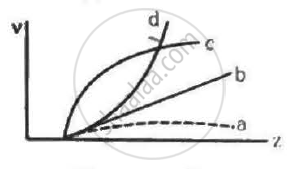
Frequencies of Kα X-rays of different materials are measured. Which one of the graphs in the figure may represent the relation between the frequency v and the atomic number Z ?
What is the wavelength of the wave whose frequency is 1012 Hz? Name the electromagnetic wave.
Answer briefly.
Why are microwaves used in radar?
What are the ultraviolet rays?
Answer briefly.
Give two uses of radio waves.
A bat moving at 10 ms−1 towards a wall sends a sound signal of 8000 Hz towards it. On reflection, it hears a sound of frequency f The value of f in Hz is close to (speed of sound = 320 ms−1)
Microwaves are electromagnetic waves with frequency in the range of.
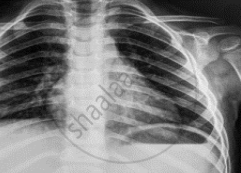
Name the electromagnetic radiation that has been used in obtaining the image below.
What is the wavelength range of electromagnetic radiation used in radio broadcast?
In an atom X, electrons absorb the energy from an external source. This energy “excites” the electrons from a lower-energy level to a higher-energy level around the nucleus of the atom. When electrons return to the ground state, they emit photons.
The figure below is the energy level diagram of atom X with three energy levels, E1 = 0.00eV, E2 = 1.78eV and E3 = 2.95eV. The ground state is considered 0 eV for reference. The transition of electrons takes place between levels E1 and E2.

- What wavelength of radiation is needed to excite the atom to energy level E2 from E1?
- Suppose the external source has a power of 100 W. What would be the rate of photon emission?
Which relation connects the speed of light in vacuum, frequency, and wavelength?
Which radiation has the longest wavelength and lowest frequency in the electromagnetic spectrum?
Which electromagnetic radiation has the highest frequency and shortest wavelength?
