Advertisements
Advertisements
Question
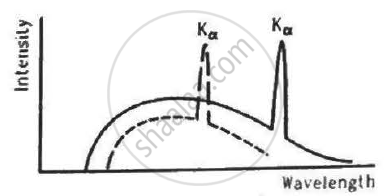
The figure shows the intensity-wavelength relations of X-rays coming from two different Coolidge tubes. The solid curve represents the relation for the tube A in which the potential difference between the target and the filament is VA and the atomic number of the target material is ZA. These quantities are VB and ZB for the other tube. Then,
Options
VA > VB, ZA > ZB
VA > VB, ZA < ZB
VA < VB, ZA > ZB
VA > VB, ZA < ZB
Advertisements
Solution
VA > VB, ZA < ZB
It is clear from the figure that the X-ray of tube A has less cutoff wavelength than the X-ray of tube B.
`therefore lambda_A < lambda_B`
Using Moseley's Law,
`Z_A < Z_B`
`lambda ∝ 1/V` , where V is the voltage applied in the X-ray tube.
`therefore V_A > V_B`
APPEARS IN
RELATED QUESTIONS
How are infrared waves produced?
A plane electromagnetic wave travels in the vacuum along the z-direction. What can you say about the directions of its electric and magnetic field vectors? If the frequency of the wave is 30 MHz, what is its wavelength?
Give a reason for the following:
Long-distance radio broadcasts use short-wave bands. Why?
Give a reason for the following:
It is necessary to use satellites for long-distance TV transmission. Why?
The small ozone layer on top of the stratosphere is crucial for human survival. Why?
Name the electromagnetic radiations used for (a) water purification, and (b) eye surgery.
In a Coolidge tube, electrons strike the target and stop inside it. Does the target get more and more negatively charged as time passes?
The energy of a photon of a characteristic X-ray from a Coolidge tube comes from
Find the cutoff wavelength for the continuous X-rays coming from an X-ray tube operating at 30 kV.
(Use Planck constant h = 4.14 × 10⁻¹⁵ eVs, speed of light c = 3 × 10⁸ m/s.)
Two waves A and B have wavelength 0.01 Å and 9000 Å respectively.
Name the two waves. compare the speeds of these waves when they travel in vacuum.
Answer briefly.
Give two uses of radio waves.
Solve the numerical problem.
Calculate the wavelength in nm of an X-ray wave of frequency 2.0 × 10¹⁸ Hz.
The ozone layer absorbs
What is time period of the light for which the eye is most sensitive?
Write two uses of the following radiation.
X-rays
At what speed do all electromagnetic waves travel in a vacuum?
Which devices commonly produce microwaves?
Which set consists of applications of infrared radiation?
