Advertisements
Advertisements
प्रश्न
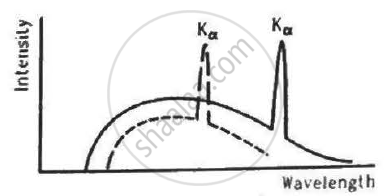
The figure shows the intensity-wavelength relations of X-rays coming from two different Coolidge tubes. The solid curve represents the relation for the tube A in which the potential difference between the target and the filament is VA and the atomic number of the target material is ZA. These quantities are VB and ZB for the other tube. Then,
पर्याय
VA > VB, ZA > ZB
VA > VB, ZA < ZB
VA < VB, ZA > ZB
VA > VB, ZA < ZB
Advertisements
उत्तर
VA > VB, ZA < ZB
It is clear from the figure that the X-ray of tube A has less cutoff wavelength than the X-ray of tube B.
`therefore lambda_A < lambda_B`
Using Moseley's Law,
`Z_A < Z_B`
`lambda ∝ 1/V` , where V is the voltage applied in the X-ray tube.
`therefore V_A > V_B`
APPEARS IN
संबंधित प्रश्न
What role dose infra-red radiation play in physical therapy?
Identify the part of the electromagnetic spectrum which is:
produced by bombarding a metal target by high speed electrons.
Give a reason for the following:
It is necessary to use satellites for long-distance TV transmission. Why?
What do you understand by the statement, "Electromagnetic waves transport momentum"?
Arrange the following radiations in the order of their increasing wavelength:
X-rays, infrared rays, ratio waves, gamma ray and microwaves.
What is the range of the wavelength of the following electromagnetic waves?
(a) Infrared.
Give one use of microwaves.
X-ray incident on a material
(a) exerts a force on it
(b) transfers energy to it
(c) transfers momentum to it
(d) transfers impulse to it.
The electric current in an X-ray tube (from the target to the filament) operating at 40 kV is 10 mA. Assume that on an average, 1% of the total kinetic energy of the electron hitting hte target are converted into X-rays.
(a) What is the total power emitted as X-rays and (b) how much heat is produced in the target every second?
Name the radiation of the electromagnetic spectrum which is used for the following:
To photograph internal parts of the human body and Give the frequency range
Answer briefly.
Why are microwaves used in radar?
Answer briefly.
What is a carrier wave?
Solve the numerical problem.
Calculate the wavelength in nm of an X-ray wave of frequency 2.0 × 10¹⁸ Hz.
Give any two uses of infrared waves.
What happens when an electron collides with a positron?
What is the wavelength range of electromagnetic radiation used in radio broadcast?
At what speed do all electromagnetic waves travel in a vacuum?
Which radiation has the longest wavelength and lowest frequency in the electromagnetic spectrum?
Which properties characterize X-rays?
