Advertisements
Advertisements
प्रश्न
Consider a photon of continuous X-ray and a photon of characteristic X-ray of the same wavelength. Which of the following is/are different for the two photons?
पर्याय
Frequency
Energy
Penetrating power
Method of creation
Advertisements
उत्तर
Method of creation
Let `λ_1` and `λ_2` be the wavelengths of the photons of continuous and characteristic X-rays, respectively.
Given :
`λ_1` = `λ_2` = `λ`
Now, frequency (`v`) is given by
`v = c/λ_1 = c/λ_2`
⇒ `v = c/λ`
Hence, the frequency of both the photons is the same.
Energy of a photon (E) is given by
`E = hv`
As the frequency of both the photons is the same, they will have the same energy.
The photon of the continuous X-ray and the photon of the characteristic X-ray consist of the same penetrating power.
The photon of the characteristic X-ray is created because of the transition of an electron from one shell to another. The photon of the continuous X-ray is created because of the conversion of the kinetic energy of an electron into a photon of electromagnetic radiation.
APPEARS IN
संबंधित प्रश्न
Name the phenomenon which shows the quantum nature of electromagnetic radiation.
State the approximate range of wavelength associated with infrared rays.
Give one use of microwaves.
Give one use of ultraviolet radiation.
An electromagnetic wave has a frequency of 500 MHz and a wavelength of 60 cm Calculate the velocity of the wave.
Name of physical quantity which remains same for microwaves of wavelength 1 mm and UV radiations of 1600 Å in vacuum.
If the potential difference applied to the tube is doubled and the separation between the filament and the target is also doubled, the cutoff wavelength
The X-ray beam emerging from an X-ray tube
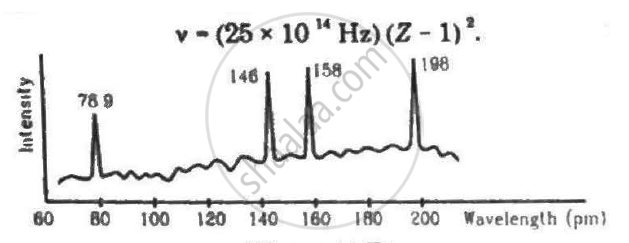
Continuous X-rays are made to strike a tissue paper soaked with polluted water. The incoming X-rays excite the atoms of the sample by knocking out the electrons from the inner shells. Characteristic X-rays are analysed and the intensity is plotted against the wavelength. Assuming that only Kα intensities are detected, list the elements present in the sample from the plot. Use Moseley's equation v − (25 × 1014Hz)(Z − 1)2.
(Use Planck constant h = 6.63 × 10⁻³⁴ Js= 4.14 × 10⁻¹⁵ eVs, speed of light c = 3 × 10⁸ m/s.)
State two properties of infrared radiations which differ from visible light.
Solve the numerical problem.
Calculate the wavelength in nm of an X-ray wave of frequency 2.0 × 10¹⁸ Hz.
The frequency of x-rays, y-rays and ultraviolet rays are respectively a, b and c. Then:-
Following QN ∴ 14, the radiation force on the roof will be
One requires 11eV of energy to dissociate a carbon monoxide molecule into carbon and oxygen atoms. The minimum frequency of the appropriate electromagnetic radiation to achieve the dissociation lies in ______.
Electromagnetic waves of wavelengths λ1, λ2 and λ3 are used in a radar system, in water purifiers and in remote switches of TV, respectively.
- Identify the electromagnetic waves.
- Write one source for each of them.
Identify the part of the electromagnetic spectrum which:
- produces the heating effect.
- is absorbed by the ozone layer in the atmosphere.
- is used for studying crystal structure.
Write any one method of the production of each of the above radiations.
Which part of the electromagnetic spectrum is known as the visible spectrum?
Which devices commonly produce microwaves?
Which electromagnetic radiation has the highest frequency and shortest wavelength?
Which are uses of gamma rays?
