Advertisements
Advertisements
प्रश्न
Solve the numerical problem.
Calculate the frequency in MHz of a radio wave of wavelength 250 m. Remember that the speed of all EM waves in a vacuum is 3.0 × 10⁸ m/s.
Advertisements
उत्तर
Given: λ = 250 m, c = 3 × 10⁸ m/s
To find: Frequency (ν)
Formula: c = νλ
Calculation: From formula,
ν = `"c"/λ=(3xx10^8)/250` = 1.2 × 10⁶ Hz = 1.2 MHz
The frequency of a radio wave is 1.2 MHz.
APPEARS IN
संबंधित प्रश्न
To which part of electromagnetic spectrum does a wave of frequency 3 × 10¹³ Hz belong?
State an additional use of the X-rays waves
What is the range of the wavelength of the following electromagnetic waves?
(A) Radio waves.
What do you understand by the invisible spectrum?
Name the waves produced by the changes in the nucleus of an atom.
Name two sources, each of infrared radiations and ultraviolet radiations.
When a Coolidge tube is operated for some time it becomes hot. Where does the heat come from?
Can Lα X-ray of one material have shorter wavelength than Kα X-ray of another?
Can a hydrogen atom emit characteristic X-rays?
If the potential difference applied to the tube is doubled and the separation between the filament and the target is also doubled, the cutoff wavelength
For a given material, the energy and wavelength of characteristic X-rays satisfy
(a) E(Kα) > E(Kβ) > E(Kγ)
(b) E(Mα) > E(Lα) > E(Kα)
(c) λ(Kα) > λ(Kβ) > λ(Kγ)
(d) λ(Mα) > λ(Lα) > λ(Kα).
The Kα and Kβ X-rays of molybdenum have wavelengths 0.71 A and 0.63 A respectively. Find the wavelength of Lα X-ray of molybdenum.
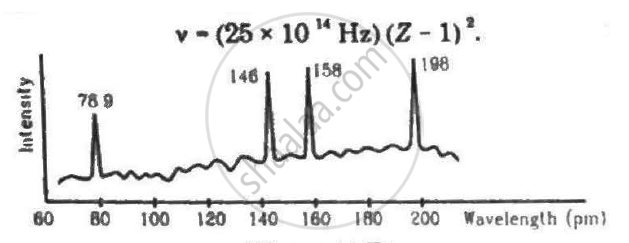
Continuous X-rays are made to strike a tissue paper soaked with polluted water. The incoming X-rays excite the atoms of the sample by knocking out the electrons from the inner shells. Characteristic X-rays are analysed and the intensity is plotted against the wavelength. Assuming that only Kα intensities are detected, list the elements present in the sample from the plot. Use Moseley's equation v − (25 × 1014Hz)(Z − 1)2.
(Use Planck constant h = 6.63 × 10⁻³⁴ Js= 4.14 × 10⁻¹⁵ eVs, speed of light c = 3 × 10⁸ m/s.)
Name the scientist who discovered radio waves
Name three radiations and their wavelength range which are invisible and beyond the violet end of the visible spectrum.
Name the radiation of the electromagnetic spectrum which is used for the following:
For taking photographs of the sky during the night and foggy conditions . Give the frequency range
Answer briefly.
Name the most harmful radiation entering the Earth's atmosphere from outer space.
Solve the numerical problem.
The speed of light is 3 × 10⁸ m/s. Calculate the frequency of red light of a wavelength of 6.5 × 10⁻⁷ m.
If the Earth did not have atmosphere, would its average surface temperature be higher or lower than what it is now? Explain.
A car is moving towards a high cliff. The car driver sounds a horn of frequency f. The reflected sound heard by the driver has a frequency 2f. If v be the velocity of sound, then the velocity of the car, in the same velocity units, will be:
The frequency of x-rays, y-rays and ultraviolet rays are respectively a, b and c. Then:-
Identify the electromagnetic wave whose wavelength range is from about 10-12 m to about 10-8 m. Write one use of this.
In an atom X, electrons absorb the energy from an external source. This energy “excites” the electrons from a lower-energy level to a higher-energy level around the nucleus of the atom. When electrons return to the ground state, they emit photons.
The figure below is the energy level diagram of atom X with three energy levels, E1 = 0.00eV, E2 = 1.78eV and E3 = 2.95eV. The ground state is considered 0 eV for reference. The transition of electrons takes place between levels E1 and E2.

- What wavelength of radiation is needed to excite the atom to energy level E2 from E1?
- Suppose the external source has a power of 100 W. What would be the rate of photon emission?
Which relation connects the speed of light in vacuum, frequency, and wavelength?
Which group of activities uses radio waves?
Where does infrared radiation lie relative to visible light?
Which electromagnetic radiation has the highest frequency and shortest wavelength?
