Advertisements
Advertisements
प्रश्न
State the name and the range of wavelength of the invisible electromagnetic waves beyond the red end of the visible spectrum.
Advertisements
उत्तर
The electromagnetic waves beyond the red end of the spectrum are known as infrared radiations.
Range: 8000 Å to 107Å (or 800 nm to 1 mm)
APPEARS IN
संबंधित प्रश्न
What are ultraviolet radiations?
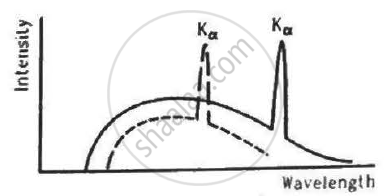
The figure shows the intensity-wavelength relations of X-rays coming from two different Coolidge tubes. The solid curve represents the relation for the tube A in which the potential difference between the target and the filament is VA and the atomic number of the target material is ZA. These quantities are VB and ZB for the other tube. Then,
When 40 kV is applied across an X-ray tube, X-ray is obtained with a maximum frequency of 9.7 × 10¹⁸ Hz. Calculate the value of Planck constant from these data.
(Use Planck constant h = 6.63 × 10⁻³⁴ Js= 4.14 × 10⁻¹⁵ eVs, speed of light c = 3 × 10⁸ m/s.)
Write the range of the wavelength of the following electromagnetic radiations:
(a) Infrared rays
(b) Ultraviolet rays
(c) γ -rays
Write one use of each of the above.
Two waves A and B have wavelength 0.01 Å and 9000 Å respectively.
Name the two waves. compare the speeds of these waves when they travel in vacuum.
Answer briefly.
Give two uses of radio waves.
Which of the following is a tool used for separating the different color wavelengths from each other?
The ratio of contributions made by the electric field and magnetic field components to the intensity of an EM wave is ______.
The magnetic field of a beam emerging from a filter facing a floodlight is given by B0 = 12 × 10–8 sin (1.20 × 10⁷z – 3.60 × 10¹⁵t) T. What is the average intensity of the beam?
Identify the electromagnetic wave whose wavelength range is from about 10-12 m to about 10-8 m. Write one use of this.
