Advertisements
Advertisements
प्रश्न
Solve the numerical problem.
The speed of light is 3 × 10⁸ m/s. Calculate the frequency of red light of a wavelength of 6.5 × 10⁻⁷ m.
Advertisements
उत्तर
Given: c = 3 × 10⁸ m/s, λ = 6.5 × 10⁻⁷ m
To find: Frequency (ν)
Formula: c = νλ
Calculation: From formula,
ν = `"c"/λ=(3xx10^8)/(6.5xx10^-7)` = 4.6 × 10¹⁴ Hz
The frequency of red light is 4.6 × 10¹⁴ Hz.
APPEARS IN
संबंधित प्रश्न
Identify the part of the electromagnetic spectrum which is suitable for radar system used in aircraft navigation.
If the earth did not have atmosphere, would its average surface temperature be higher or lower than what it is now? Explain.
Use the formula λm T= 0.29 cm K to obtain the characteristic temperature ranges for different parts of the electromagnetic spectrum. What do the numbers that you obtain tell you?
State the approximate range of wavelength associated with the ultraviolet rays.
Name two sources, each of infrared radiations and ultraviolet radiations.
Characteristic X-rays may be used to identify the element from which they are being emitted. Can continuous X-rays be used for this purpose?
Moseley's Law for characteristic X-ray is √v = a(Z − b). Here,
Write the range of the wavelength of the following electromagnetic radiations:
(a) Infrared rays
(b) Ultraviolet rays
(c) γ -rays
Write one use of each of the above.
Name the scientist who discovered Microwaves
Name the part of the electromagnetic spectrum which is:
Produced by bombarding a metal target with high electrons.
Name two sources of ultraviolet radiation.
Name two sources of infrared radiation.
Give one use of electromagnetic radiations in Infrared radiation.
Answer briefly.
Why are microwaves used in radar?
Answer briefly.
Give two uses of radio waves.
Solve the numerical problem.
Calculate the wavelength in nm of an X-ray wave of frequency 2.0 × 10¹⁸ Hz.
If the Earth did not have atmosphere, would its average surface temperature be higher or lower than what it is now? Explain.
Light of wavelength `3500A` is incident on two metals A and B whose work functions are 3.2 eV and 1.9 eV respectively. Which metal will emit photoelectrons?
Electromagnetic waves with wavelength
- λ1 is used in satellite communication.
- λ2 is used to kill germs in water purifies.
- λ3 is used to detect leakage of oil in underground pipelines.
- λ4 is used to improve visibility in runways during fog and mist conditions.
- Identify and name the part of electromagnetic spectrum to which these radiations belong.
- Arrange these wavelengths in ascending order of their magnitude.
- Write one more application of each.
Write two uses of the following radiation.
X-rays
Name one radiation having the wavelength longer than the wavelength of these radiations.
Name the electromagnetic radiation that has been used in obtaining the image below.
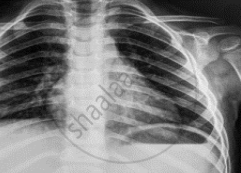
What is the wavelength range of electromagnetic radiation used in radio broadcast?
What do electromagnetic waves require for propagation?
Which radiation has the longest wavelength and lowest frequency in the electromagnetic spectrum?
Which are uses of gamma rays?
