Advertisements
Advertisements
प्रश्न
Calculate the wavelength of a microwave of a frequency of 8.0 GHz.
Advertisements
उत्तर
Given: ν = 8 GHz = 8 × 10⁹ Hz, c = 3 × 10⁸ m/s
To find: Wavelength (λ)
Formula: c = νλ
Calculation: From formula,
λ = `"c"/ν`
= `(3xx10^8)/(8xx10^9)`
= 3.75 × 10−2
= 3.75 cm
The wavelength of microwave is 3.75 cm.
APPEARS IN
संबंधित प्रश्न
If the earth did not have atmosphere, would its average surface temperature be higher or lower than what it is now? Explain.
If the earth did not have an atmosphere, would its average surface temperature be higher or lower than what it is now?
A wave has wavelength 50 Å.
- Name the wave.
- State its speed in vacuum.
- State its one use.
Name the electromagnetic radiations used for (a) water purification, and (b) eye surgery.
Name the waves produced by the changes in the nucleus of an atom.
Is it possible that in a Coolidge tube characteristic Lα X-rays are emitted but not Kα X-rays?
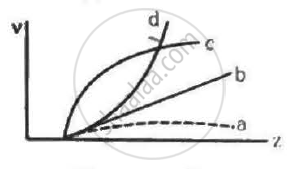
Frequencies of Kα X-rays of different materials are measured. Which one of the graphs in the figure may represent the relation between the frequency v and the atomic number Z ?
Cutoff wavelength of X-rays coming from a Coolidge tube depends on the
(a) target material
(b) accelerating voltage
(c) separation between the target and the filament
(d) temperature of the filament.
The Kβ X-ray of argon has a wavelength of 0.36 nm. The minimum energy needed to ionize an argon atom is 16 eV. Find the energy needed to knock out an electron from the K shell of an argon atom.
The electric current in an X-ray tube (from the target to the filament) operating at 40 kV is 10 mA. Assume that on an average, 1% of the total kinetic energy of the electron hitting hte target are converted into X-rays.
(a) What is the total power emitted as X-rays and (b) how much heat is produced in the target every second?
The wavelengths of Kα and Lα X-rays of a material are 21.3 pm and 141 pm respectively. Find the wavelength of Kβ X-ray of the material.
(Use Planck constant h = 6.63 × 10⁻³⁴ Js= 4.14 × 10⁻¹⁵ eVs, speed of light c = 3 × 10⁸ m/s.)
The distance between the cathode (filament) and the target in an X-ray tube is 1.5 m. If the cutoff wavelength is 30 pm, find the electric field between the cathode and the target.
(Use Planck constant h = 6.63 × 10⁻³⁴ Js= 4.14 × 10⁻¹⁵ eVs, speed of light c = 3 × 10⁸ m/s.)
Name the scientist who discovered Infra-red waves
Name any two electromagnetic waves which have a frequency higher than that of violet light. State one use of each.
State two properties of infrared radiations which differ from visible light.
Give one use of electromagnetic radiation in Microwaves.
Name the radiations used for the detection of fracture in bones.
Answer briefly.
Why are microwaves used in radar?
X-rays, gamma rays and microwaves travelling in a vacuum have ______.
Radio waves of constant amplitude can be generated with.
If λv, λx and λm Am represents the wavelength of visible light, x-ray and microwaves respectively, then ______.
Photons of an electromagnetic radiation has an energy 11 keV each. To which region of electromagnetic spectrum does it belong?
Choose the correct option related to wavelengths (λ) of different parts of the electromagnetic spectrum.
What happens when an electron collides with a positron?
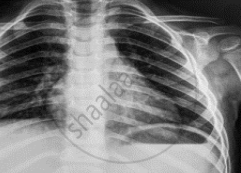
Name the electromagnetic radiation that has been used in obtaining the image below.
What do electromagnetic waves require for propagation?
Why can a microwave oven heat food?
How does the frequency of violet light compare with that of red light?
Where do ultraviolet rays lie relative to visible light?
