Advertisements
Advertisements
Question
Calculate the wavelength of a microwave of a frequency of 8.0 GHz.
Advertisements
Solution
Given: ν = 8 GHz = 8 × 10⁹ Hz, c = 3 × 10⁸ m/s
To find: Wavelength (λ)
Formula: c = νλ
Calculation: From formula,
λ = `"c"/ν`
= `(3xx10^8)/(8xx10^9)`
= 3.75 × 10−2
= 3.75 cm
The wavelength of microwave is 3.75 cm.
APPEARS IN
RELATED QUESTIONS
To which part of electromagnetic spectrum does a wave of frequency 3 × 10¹³ Hz belong?
Give a reason for the following:
Long-distance radio broadcasts use short-wave bands. Why?
Optical and radio telescopes are built on the ground but X-ray astronomy is possible only from satellites orbiting the earth. Why?
What is the range of the wavelength of the following electromagnetic waves?
(a) Gamma rays.
Name of physical quantity which remains same for microwaves of wavelength 1 mm and UV radiations of 1600 Å in vacuum.
Can X-rays be used for photoelectric effect?
X-ray from a Coolidge tube is incident on a thin aluminium foil. The intensity of the X-ray transmitted by the foil is found to be I0. The heating current is increased to increase the temperature of the filament. The intensity of the X-ray transmitted by the foil will be
(a) zero
(b) < I0
(c) I0
(d) > I0
X-ray incident on a material
(a) exerts a force on it
(b) transfers energy to it
(c) transfers momentum to it
(d) transfers impulse to it.
The X-ray coming from a Coolidge tube has a cutoff wavelength of 80 pm. Find the kinetic energy of the electrons hitting the target.
(Use Planck constant h = 6.63 × 10⁻³⁴ Js= 4.14 × 10⁻¹⁵ eVs, speed of light c = 3 × 10⁸ m/s.)
Identify the part of the electromagnetic spectrum used in
(i) radar and
(ii) eye surgery. Write their frequency range.
Name the radiation of the electromagnetic spectrum which is used for the following:
For taking photographs of the sky during the night and foggy conditions . Give the frequency range
How will you investigate the existence of the radiation beyond the red and violet extremes of the spectrum?
State three properties of ultra-violet radiation similar to visible light.
What are the ultraviolet rays?
Answer briefly.
Name the most harmful radiation entering the Earth's atmosphere from outer space.
Solve the numerical problem.
The speed of light is 3 × 10⁸ m/s. Calculate the frequency of red light of a wavelength of 6.5 × 10⁻⁷ m.
An electron beam is accelerated by a potential difference V to hit a metallic target to produce X-rays. It produces continuous as well as characteristic X-rays. If λmin is the smallest possible wavelength of X-ray in the spectrum, the variation of log λmin with log V is correctly represented in:
The ozone layer absorbs
SONAR emits which of the following waves?
All components of the electromagnetic spectrum in a vacuum have the same ______
The magnetic field of a beam emerging from a filter facing a floodlight is given by B0 = 12 × 10–8 sin (1.20 × 10⁷z – 3.60 × 10¹⁵t) T. What is the average intensity of the beam?
Electromagnetic waves with wavelength
- λ1 is suitable for radar systems used in aircraft navigation.
- λ2 is used to kill germs in water purifiers.
- λ3 is used to improve visibility in runways during fog and mist conditions.
Identify and name the part of the electromagnetic spectrum to which these radiations belong. Also arrange these wavelengths in ascending order of their magnitude.
Arrange the following electromagnetic radiation in the ascending order of their frequencies:
X-rays, microwaves, gamma rays, radio waves
Choose the correct option related to wavelengths (λ) of different parts of the electromagnetic spectrum.
Assertion (A): Ultraviolet radiations is scattered more as compared to the microwave radiations.
Reason (R): Wavelength of ultraviolet radiation is more than the wavelength of microwave radiation.
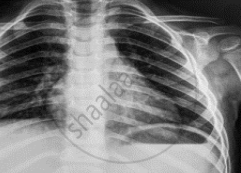
Name the electromagnetic radiation that has been used in obtaining the image below.
What happens to wavelength as the frequency of electromagnetic radiation increases?
Why can a microwave oven heat food?
