Advertisements
Advertisements
Question
Suppose a monochromatic X-ray beam of wavelength 100 pm is sent through a Young's double slit and the interference pattern is observed on a photographic plate placed 40 cm away from the slit. What should be the separation between the slits so that the successive maxima on the screen are separated by a distance of 0.1 mm?
Advertisements
Solution
Given:
`lambda = 10 "pm" = 100 xx 10^-12 "m"`
`D = 40 "cm" = 40 xx 10^-2 "m"`
`β = 0.1 "mm" = 0.1 xx 10^-3 "m"`
`β = (lambdaD)/d`
`d = (lambdaD)/β`
= `(100 xx 10^-12 xx 40 xx 10^-2)/(10^-3 xx 0.1)`
= `4 xx 10^-7 "m"`
APPEARS IN
RELATED QUESTIONS
Use the formula λm T= 0.29 cm K to obtain the characteristic temperature ranges for different parts of the electromagnetic spectrum. What do the numbers that you obtain tell you?
State an additional use of the X-rays waves
Arrange the following radiations in the order of their increasing wavelength:
X-rays, infrared rays, ratio waves, gamma ray and microwaves.
What is the range of the wavelength of the following electromagnetic waves?
(a) Visible.
State the approximate range of wavelength associated with the ultraviolet rays.
Name of physical quantity which remains same for microwaves of wavelength 1 mm and UV radiations of 1600 Å in vacuum.
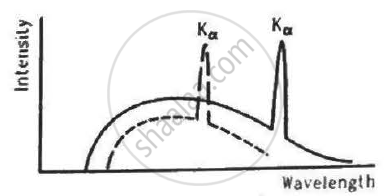
The figure shows the intensity-wavelength relations of X-rays coming from two different Coolidge tubes. The solid curve represents the relation for the tube A in which the potential difference between the target and the filament is VA and the atomic number of the target material is ZA. These quantities are VB and ZB for the other tube. Then,
Visible light passing through a circular hole forms a diffraction disc of radius 0.1 mm on a screen. If an X-ray is passed through the same setup, the radius of the diffraction disc will be
X-ray incident on a material
(a) exerts a force on it
(b) transfers energy to it
(c) transfers momentum to it
(d) transfers impulse to it.
The X-ray coming from a Coolidge tube has a cutoff wavelength of 80 pm. Find the kinetic energy of the electrons hitting the target.
(Use Planck constant h = 6.63 × 10⁻³⁴ Js= 4.14 × 10⁻¹⁵ eVs, speed of light c = 3 × 10⁸ m/s.)
Name the scientist who discovered radio waves
Define the term "Intensity" in the photon picture of electromagnetic radiation.
State three properties of ultra-violet radiation similar to visible light.
What is the wavelength of the wave whose frequency is 1012 Hz? Name the electromagnetic wave.
The ratio of contributions made by the electric field and magnetic field components to the intensity of an EM wave is ______.
Why does microwave oven heats up a food item containing water molecules most efficiently?
Write two uses of the following radiation.
X-rays
Name one radiation having the wavelength longer than the wavelength of these radiations.
