Advertisements
Advertisements
Question
Two waves A and B have wavelength 0.01 Å and 9000 Å respectively.
- Name the two waves.
- Compare the speeds of these waves when they travel in vacuum.
Advertisements
Solution
- A - gamma rays, B - infrared radiation.
- The ratio of the speeds of these waves in a vacuum is 1:1, as all electromagnetic waves travel at the speed of light in a vacuum.
APPEARS IN
RELATED QUESTIONS
If the earth did not have atmosphere, would its average surface temperature be higher or lower than what it is now? Explain.
The wavelengths for the light of red and blue colours are roughly 7.8 × `10^7` m and 4.8 × `10^7` m respectively.
(a) Which colour has the greater speed in vacuum?
(b) Which colour has the greater speed in glass?
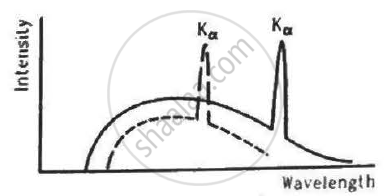
The figure shows the intensity-wavelength relations of X-rays coming from two different Coolidge tubes. The solid curve represents the relation for the tube A in which the potential difference between the target and the filament is VA and the atomic number of the target material is ZA. These quantities are VB and ZB for the other tube. Then,
The short-wavelength limit shifts by 26 pm when the operating voltage in an X-ray tube is increased to 1.5 times the original value. What was the original value of the operating voltage?
(Use Planck constant h = 6.63 × 10⁻³⁴ Js= 4.14 × 10⁻¹⁵ eVs, speed of light c = 3 × 10⁸ m/s.)
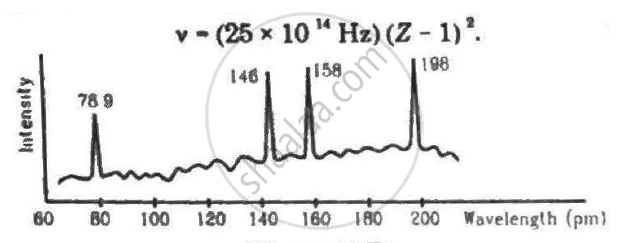
Continuous X-rays are made to strike a tissue paper soaked with polluted water. The incoming X-rays excite the atoms of the sample by knocking out the electrons from the inner shells. Characteristic X-rays are analysed and the intensity is plotted against the wavelength. Assuming that only Kα intensities are detected, list the elements present in the sample from the plot. Use Moseley's equation v − (25 × 1014Hz)(Z − 1)2.
(Use Planck constant h = 6.63 × 10⁻³⁴ Js= 4.14 × 10⁻¹⁵ eVs, speed of light c = 3 × 10⁸ m/s.)
Answer briefly.
Why high-frequency carrier waves are used for the transmission of audio signals?
What happens to the intensity of light from a bulb if the distance from the bulb is doubled? As a laser beam travels across the length of a room, its intensity essentially remains constant. What geometrical characteristic of LASER beam is responsible for the constant intensity which is missing in the case of light from the bulb?
Arrange the following electromagnetic radiation in the ascending order of their frequencies:
X-rays, microwaves, gamma rays, radio waves
Which is the correct ascending order of wavelengths?
