Advertisements
Advertisements
Question
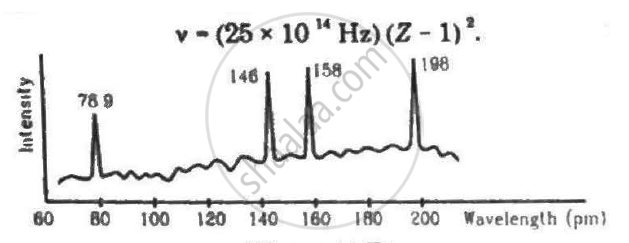
Continuous X-rays are made to strike a tissue paper soaked with polluted water. The incoming X-rays excite the atoms of the sample by knocking out the electrons from the inner shells. Characteristic X-rays are analysed and the intensity is plotted against the wavelength. Assuming that only Kα intensities are detected, list the elements present in the sample from the plot. Use Moseley's equation v − (25 × 1014Hz)(Z − 1)2.
(Use Planck constant h = 6.63 × 10⁻³⁴ Js= 4.14 × 10⁻¹⁵ eVs, speed of light c = 3 × 10⁸ m/s.)
Advertisements
Solution
Given :-
`f = (25 × 10^14 "Hz") (Z − 1)^2`
`or c/lambda = 25 xx 10^14(Z - 1)^2`
(a) `(3 xx 10^8)/(78.9 xx 10^-12 xx 25 xx 10^14)` = `(Z - 1)^2`
or `(Z - 1)^2 = 0.001520 xx 10^6 = 1520`
`⇒ Z - 1 = 38.98`
`or Z = 39.98 = 40`
Thus , it is (Zr) .
(b) `(3 xx 10^8)/(146 xx 10^-12 xx 25 xx 10^14)` = `(Z - 1)^2`
`or (Z - 1)^2 = 0.00082219 xx 10^6`
`or Z - 1 = 28.669`
`or Z = 29.669 = 30`
Thus , it is (Zn).
(c) `(3 xx 10^8)/(158 xx 10^-12 xx 25 xx 10^14) = (Z - 1)^2`
`or (Z -1)^2 = 0.0007594 xx 10^4`
`or Z - 1 = 27.5559`
`or Z - 1 = 28.5589 = 29`
Thus , it is (Cu).
(d) `(3 xx 10^8)/(198 xx 10^-12 xx 25 xx 10^14) = (Z - 1)^2`
`or (Z - 1)^2 = 0.000606 xx 10^4`
`or Z-1 = 24.6162`
`or Z = 25.6162 = 26`
Thus , it is (Fe).
APPEARS IN
RELATED QUESTIONS
To which part of the electromagnetic spectrum does a wave of frequency 5 × 10¹⁹ Hz belong?
The small ozone layer on top of the stratosphere is crucial for human survival. Why?
A wave has wavelength 50 Å.
- Name the wave.
- State its speed in vacuum.
- State its one use.
The wavelengths for the light of red and blue colours are roughly 7.8 × `10^7` m and 4.8 × `10^7` m respectively.
(a) Which colour has the greater speed in vacuum?
(b) Which colour has the greater speed in glass?
The Kβ X-ray of argon has a wavelength of 0.36 nm. The minimum energy needed to ionize an argon atom is 16 eV. Find the energy needed to knock out an electron from the K shell of an argon atom.
The Kα and Kβ X-rays of molybdenum have wavelengths 0.71 A and 0.63 A respectively. Find the wavelength of Lα X-ray of molybdenum.
The Kα and Kβ X-rays of molybdenum have wavelengths 0.71 A and 0.63 A respectively. Find the wavelength of Lα X-ray of molybdenum.
(Use Planck constant h = 6.63 × 10⁻³⁴ Js= 4.14 × 10⁻¹⁵ eVs, speed of light c = 3 × 10⁸ m/s.)
Identify the part of the electromagnetic spectrum used in (i) radar and (ii) eye surgery. Write their frequency range.
Choose the correct option.
The EM wave emitted by the Sun and responsible for heating the Earth’s atmosphere due to greenhouse effect is
What are the ultraviolet rays?
Microwaves are electromagnetic waves with frequency in the range of.
Photons of an electromagnetic radiation has an energy 11 keV each. To which region of electromagnetic spectrum does it belong?
Identify the electromagnetic wave whose wavelength range is from about 10-3 m to about 10-1 m. Write one use of this.
Identify the electromagnetic radiation and write its wavelength range, which is used to kill germs in water purified. Name the two sources of these radiations.
At what speed do all electromagnetic waves travel in a vacuum?
Which relation connects the speed of light in vacuum, frequency, and wavelength?
In \[c = \nu\lambda\], what do \[c\], \[\nu\], and \[\lambda\] represent?
Which group of activities uses radio waves?
How does the frequency of violet light compare with that of red light?
Which are uses of gamma rays?
