Advertisements
Advertisements
Question
Heat at the rate of 200 W is produced in an X-ray tube operating at 20 kV. Find the current in the circuit. Assume that only a small fraction of the kinetic energy of electrons is converted into X-rays.
Advertisements
Solution
Given:-
Heat produced/second = Power (P) = 200 W
Potential in the X ray tube, V = 20 kV
We know
Power, P = VI
Here, V = potential difference
I = current
But `l = (n e)/t`
Where, e = charge on electron
t = time
n = no of electrons
`therefore P = (n eV)/t`
`⇒ 200 = (n eV)/t`
`⇒ (n e"/"t)V = 200`
`⇒ I = 200/V`
`⇒ I = 200/(20 xx 10^3) = 10 "mA"`
APPEARS IN
RELATED QUESTIONS
What role dose infra-red radiation play in physical therapy?
The wavelengths for the light of red and blue colours are roughly 7.8 × `10^7` m and 4.8 × `10^7` m respectively.
(a) Which colour has the greater speed in vacuum?
(b) Which colour has the greater speed in glass?
Give one use of microwaves.
Name the waves used for taking photographs in dark.
Name three properties of ultraviolet radiations which are similar to visible light.
X-ray and visible light travel at the same speed in vacuum. Do they travel at the same speed in glass?
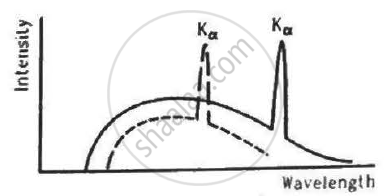
The figure shows the intensity-wavelength relations of X-rays coming from two different Coolidge tubes. The solid curve represents the relation for the tube A in which the potential difference between the target and the filament is VA and the atomic number of the target material is ZA. These quantities are VB and ZB for the other tube. Then,
Name the radiation of the electromagnetic spectrum which is used for the following:
Radar and Give the frequency range.
Answer briefly.
Does an ordinary electric lamp emit EM waves?
What are the ultraviolet rays?
Solve the numerical problem.
Calculate the frequency in MHz of a radio wave of wavelength 250 m. Remember that the speed of all EM waves in a vacuum is 3.0 × 10⁸ m/s.
One requires 11eV of energy to dissociate a carbon monoxide molecule into carbon and oxygen atoms. The minimum frequency of the appropriate electromagnetic radiation to achieve the dissociation lies in ______.
The ratio of contributions made by the electric field and magnetic field components to the intensity of an EM wave is ______.
Electromagnetic waves with wavelength
- λ1 is suitable for radar systems used in aircraft navigation.
- λ2 is used to kill germs in water purifiers.
- λ3 is used to improve visibility in runways during fog and mist conditions.
Identify and name the part of the electromagnetic spectrum to which these radiations belong. Also arrange these wavelengths in ascending order of their magnitude.
Arrange the following electromagnetic radiation in the ascending order of their frequencies:
X-rays, microwaves, gamma rays, radio waves
Electromagnetic waves of wavelengths λ1, λ2 and λ3 are used in a radar system, in water purifiers and in remote switches of TV, respectively.
- Identify the electromagnetic waves.
- Write one source for each of them.
Name one radiation having the wavelength longer than the wavelength of these radiations.
Which part of the electromagnetic spectrum is known as the visible spectrum?
How does the frequency of infrared radiation compare with that of microwaves?
