Advertisements
Advertisements
Questions
Write two uses of the following radiation.
X-rays
Give any two uses of X-rays.
Advertisements
Solution
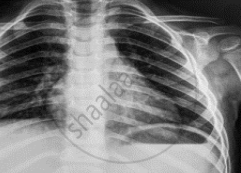
- X-rays are used in medical diagnostics to find bone fractures, lung TB, gall bladder stones, and kidney stones.
- They are employed in engineering to inspect bridge defects.
- To inspect industrial materials for cracks or defects.
APPEARS IN
RELATED QUESTIONS
What role dose infra-red radiation play in maintain the Earth’s warmth
A plane electromagnetic wave travels in the vacuum along the z-direction. What can you say about the directions of its electric and magnetic field vectors? If the frequency of the wave is 30 MHz, what is its wavelength?
Why are infra-red waves often called heat waves? Explain.
In a Coolidge tube, electrons strike the target and stop inside it. Does the target get more and more negatively charged as time passes?
A certain element emits Kα X-ray of energy 3.69 keV. Use the data from the previous problem to identify the element.
(Use Planck constant h = 6.63 × 10⁻³⁴ Js= 4.14 × 10⁻¹⁵ eVs, speed of light c = 3 × 10⁸ m/s.)
The energy of a silver atom with a vacancy in K shell is 25.31 keV, in L shell is 3.56 keV and in M shell is 0.530 keV higher than the energy of the atom with no vacancy. Find the frequency of Kα, Kβ and Lα X-rays of silver.
(Use Planck constant h = 6.63 × 10⁻³⁴ Js= 4.14 × 10⁻¹⁵ eVs, speed of light c = 3 × 10⁸ m/s.)
Name the scientist who discovered Microwaves
Answer briefly.
Can we produce a pure electric or magnetic wave in space? Why?
Microwaves are electromagnetic waves with frequency in the range of.
Name the electromagnetic radiation that has been used in obtaining the image below.