Advertisements
Advertisements
प्रश्न
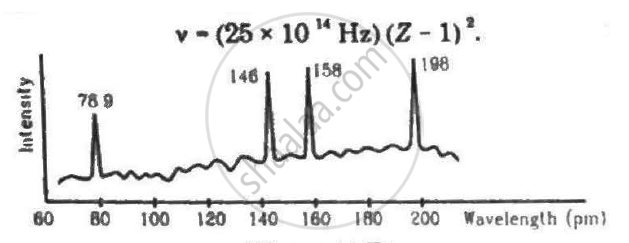
Continuous X-rays are made to strike a tissue paper soaked with polluted water. The incoming X-rays excite the atoms of the sample by knocking out the electrons from the inner shells. Characteristic X-rays are analysed and the intensity is plotted against the wavelength. Assuming that only Kα intensities are detected, list the elements present in the sample from the plot. Use Moseley's equation v − (25 × 1014Hz)(Z − 1)2.
(Use Planck constant h = 6.63 × 10⁻³⁴ Js= 4.14 × 10⁻¹⁵ eVs, speed of light c = 3 × 10⁸ m/s.)
Advertisements
उत्तर
Given :-
`f = (25 × 10^14 "Hz") (Z − 1)^2`
`or c/lambda = 25 xx 10^14(Z - 1)^2`
(a) `(3 xx 10^8)/(78.9 xx 10^-12 xx 25 xx 10^14)` = `(Z - 1)^2`
or `(Z - 1)^2 = 0.001520 xx 10^6 = 1520`
`⇒ Z - 1 = 38.98`
`or Z = 39.98 = 40`
Thus , it is (Zr) .
(b) `(3 xx 10^8)/(146 xx 10^-12 xx 25 xx 10^14)` = `(Z - 1)^2`
`or (Z - 1)^2 = 0.00082219 xx 10^6`
`or Z - 1 = 28.669`
`or Z = 29.669 = 30`
Thus , it is (Zn).
(c) `(3 xx 10^8)/(158 xx 10^-12 xx 25 xx 10^14) = (Z - 1)^2`
`or (Z -1)^2 = 0.0007594 xx 10^4`
`or Z - 1 = 27.5559`
`or Z - 1 = 28.5589 = 29`
Thus , it is (Cu).
(d) `(3 xx 10^8)/(198 xx 10^-12 xx 25 xx 10^14) = (Z - 1)^2`
`or (Z - 1)^2 = 0.000606 xx 10^4`
`or Z-1 = 24.6162`
`or Z = 25.6162 = 26`
Thus , it is (Fe).
APPEARS IN
संबंधित प्रश्न
What role dose infra-red radiation play in physical therapy?
Optical and radio telescopes are built on the ground but X-ray astronomy is possible only from satellites orbiting the earth. Why?
The wavelengths for the light of red and blue colours are roughly 7.8 × `10^7` m and 4.8 × `10^7` m respectively.
(a) Which colour has the greater speed in vacuum?
(b) Which colour has the greater speed in glass?
Two waves A and B have wavelength 0.01 Å and 9000 Å respectively.
- Name the two waves.
- Compare the speeds of these waves when they travel in vacuum.
Name of physical quantity which remains same for microwaves of wavelength 1 mm and UV radiations of 1600 Å in vacuum.
Visible light passing through a circular hole forms a diffraction disc of radius 0.1 mm on a screen. If an X-ray is passed through the same setup, the radius of the diffraction disc will be
Cutoff wavelength of X-rays coming from a Coolidge tube depends on the
(a) target material
(b) accelerating voltage
(c) separation between the target and the filament
(d) temperature of the filament.
The wavelength of Kα X-ray of tungsten is 21.3 pm. It takes 11.3 keV to knock out an electron from the L shell of a tungsten atom. What should be the minimum accelerating voltage across an X-ray tube having tungsten target which allows production of Kα X-ray?
(Use Planck constant h = 6.63 × 10⁻³⁴ Js= 4.14 × 10⁻¹⁵ eVs, speed of light c = 3 × 10⁸ m/s.)
The Kα and Kβ X-rays of molybdenum have wavelengths 0.71 A and 0.63 A respectively. Find the wavelength of Lα X-ray of molybdenum.
(Use Planck constant h = 6.63 × 10⁻³⁴ Js= 4.14 × 10⁻¹⁵ eVs, speed of light c = 3 × 10⁸ m/s.)
Calculate the shortest wavelength of electromagnetic radiation present in Balmer series of hydrogen spectrum.
Identify the part of the electromagnetic spectrum used in (i) radar and (ii) eye surgery. Write their frequency range.
Answer briefly.
Give two uses of radio waves.
The ozone layer absorbs
SONAR emits which of the following waves?
Given below in the left column are different modes of communication using the kinds of waves given in the right column.
| A. | Optical Fibre Communication |
P. | Ultrasound |
| B. | Radar | Q. | Infrared Light |
| C. | Sonar | R. | Microwaves |
| D. | Mobile Phones | S. | Radio Waves |
From the options given below, find the most appropriate match between entries in the left and the right column.
Identify the part of the electromagnetic spectrum which:
- produces the heating effect.
- is absorbed by the ozone layer in the atmosphere.
- is used for studying crystal structure.
Write any one method of the production of each of the above radiations.
Name one radiation having the wavelength longer than the wavelength of these radiations.
In \[c = \nu\lambda\], what do \[c\], \[\nu\], and \[\lambda\] represent?
What gives rise to gamma rays?
