Advertisements
Advertisements
Question
The Kβ X-ray of argon has a wavelength of 0.36 nm. The minimum energy needed to ionize an argon atom is 16 eV. Find the energy needed to knock out an electron from the K shell of an argon atom.
Advertisements
Solution
Given:-
Wavelength of Kβ X-ray of argon, λ = 0.36 nm
Energy needed to ionise an argon atom = 16 eV
Energy of Kβ X-ray of argon (E) is given by
`E = 1242/0.36 = 3450 "eV"`
Energy needed to knock out an electron from K shell
EK = (3450 + 16) eV
EK = 3466 eV ≈ 3.47 keV
APPEARS IN
RELATED QUESTIONS
If the earth did not have atmosphere, would its average surface temperature be higher or lower than what it is now? Explain.
The terminology of different parts of the electromagnetic spectrum is given in the text. Use the formula E = hv (for energy of a quantum of radiation: photon) and obtain the photon energy in units of eV for different parts of the electromagnetic spectrum. In what way are the different scales of photon energies that you obtain related to the sources of electromagnetic radiation?
The small ozone layer on top of the stratosphere is crucial for human survival. Why?
If the earth did not have an atmosphere, would its average surface temperature be higher or lower than what it is now?
Give the range of wavelength of the electromagnetic waves visible to us.
What do you understand by the invisible spectrum?
Name the waves produced by the changes in the nucleus of an atom.
For a given material, the energy and wavelength of characteristic X-rays satisfy
(a) E(Kα) > E(Kβ) > E(Kγ)
(b) E(Mα) > E(Lα) > E(Kα)
(c) λ(Kα) > λ(Kβ) > λ(Kγ)
(d) λ(Mα) > λ(Lα) > λ(Kα).
Name the radiation of the electromagnetic spectrum which is used for the following:
To photograph internal parts of the human body and Give the frequency range
Answer briefly.
Why are microwaves used in radar?
Solve the numerical problem.
The speed of light is 3 × 10⁸ m/s. Calculate the frequency of red light of a wavelength of 6.5 × 10⁻⁷ m.
The area to be covered for T.V telecast is doubled then the height of transmitting antenna (T.V tower) will have to be:-
A radio can tune to any station in the 7.5 mHz to 12 MHz band. What is corresponding wave length band.
Why does microwave oven heats up a food item containing water molecules most efficiently?
Write two uses of the following radiation.
Gamma rays
Name one radiation having the wavelength longer than the wavelength of these radiations.
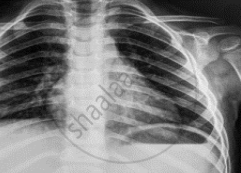
Name the electromagnetic radiation that has been used in obtaining the image below.
At what speed do all electromagnetic waves travel in a vacuum?
Why can a microwave oven heat food?
How does the frequency of violet light compare with that of red light?
