Advertisements
Advertisements
प्रश्न
Can X-rays be polarised?
Advertisements
उत्तर
Only transverse waves can be polarised. Since an X-ray is a transverse wave, it can be polarised.
APPEARS IN
संबंधित प्रश्न
Identify the part of the electromagnetic spectrum which is suitable for radar system used in aircraft navigation.
To which part of electromagnetic spectrum does a wave of frequency 3 × 10¹³ Hz belong?
What physical quantity is the same for X-rays of wavelength 10−10 m, red light of wavelength 6800 Å and radiowaves of wavelength 500 m?
A radio can tune in to any station in the 7.5 MHz to 12 MHz band. What is the corresponding wavelength band?
Name the subjective property of light related to its wavelength.
What is the range of the wavelength of the following electromagnetic waves?
(a) Visible.
Can Lα X-ray of one material have shorter wavelength than Kα X-ray of another?
If the current in the circuit for heating the filament is increased, the cutoff wavelength
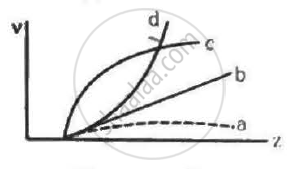
Frequencies of Kα X-rays of different materials are measured. Which one of the graphs in the figure may represent the relation between the frequency v and the atomic number Z ?
Find the maximum potential difference which may be applied across an X-ray tube with tungsten target without emitting any characteristic K or L X-ray. The energy levels of the tungsten atom with an electron knocked out are as follows.
| Cell containing vacancy | K | L | M |
| Energy in keV | 69.5 | 11.3 | 2.3 |
The Kα and Kβ X-rays of molybdenum have wavelengths 0.71 A and 0.63 A respectively. Find the wavelength of Lα X-ray of molybdenum.
A free atom of iron emits Kα X-rays of energy 6.4 keV. Calculate the recoil kinetic energy of the atom. Mass of an iron atom = 9.3 × 10⁻²⁶ kg.
(Use Planck constant h = 6.63 × 10⁻³⁴ Js= 4.14 × 10⁻¹⁵ eVs, speed of light c = 3 × 10⁸ m/s.)
Name the radiation of the electromagnetic spectrum which is used for the following:
For taking photographs of the sky during the night and foggy conditions . Give the frequency range
State three properties of infrared radiations similar to that of visible light.
Give one use of electromagnetic radiation in Microwaves.
Answer briefly.
Name the most harmful radiation entering the Earth's atmosphere from outer space.
Electromagnetic waves with wavelength
- λ1 is suitable for radar systems used in aircraft navigation.
- λ2 is used to kill germs in water purifiers.
- λ3 is used to improve visibility in runways during fog and mist conditions.
Identify and name the part of the electromagnetic spectrum to which these radiations belong. Also arrange these wavelengths in ascending order of their magnitude.
Arrange the following electromagnetic radiation in the ascending order of their frequencies:
X-rays, microwaves, gamma rays, radio waves
Below is an incomplete table showing the arrangement of electromagnetic spectrum in the increasing order of their wavelength. Complete the table:
| Gamma ray | X - ray | UV rays | Visible rays | Infrared | A | Radio waves |
- Identify the radiation A.
- Name the radiation used to detect fracture in bones.
- Name one property common to both A and Radio waves.
Which are uses of gamma rays?
