Advertisements
Advertisements
प्रश्न
When a Coolidge tube is operated for some time it becomes hot. Where does the heat come from?
Advertisements
उत्तर
A Coolidge tube apparatus consists of a filament and a target. The filament is heated to produce electrons that are accelerated by applying an electric field between the filament and the target. When these accelerated electrons enter the target, they collide with the target atoms. In the process, the electrons lose their kinetic energy. A part of this kinetic energy is utilised for emitting X-rays and the remaining energy is absorbed by the target. Inside the target, the kinetic energy of the electrons is converted into heat energy. This raises the temperature of the target and hence, it heats the Coolidge tube.
APPEARS IN
संबंधित प्रश्न
To which part of the electromagnetic spectrum does a wave of frequency 5 × 10¹⁹ Hz belong?
A radio can tune in to any station in the 7.5 MHz to 12 MHz band. What is the corresponding wavelength band?
What is the range of the wavelength of the following electromagnetic waves?
(a) Infrared.
Which part of electromagnetic spectrum is used in radar systems?
Characteristic X-rays may be used to identify the element from which they are being emitted. Can continuous X-rays be used for this purpose?
For a given material, the energy and wavelength of characteristic X-rays satisfy
(a) E(Kα) > E(Kβ) > E(Kγ)
(b) E(Mα) > E(Lα) > E(Kα)
(c) λ(Kα) > λ(Kβ) > λ(Kγ)
(d) λ(Mα) > λ(Lα) > λ(Kα).
What potential difference should be applied across an X-ray tube to get X-ray of wavelength not less than 0.10 nm? What is the maximum energy of a photon of this X-ray in joule?
(Use Planck constant h = 6.63 × 10⁻³⁴ Js= 4.14 × 10⁻¹⁵ eVs, speed of light c = 3 × 10⁸ m/s.)
If the operating potential in an X-ray tube is increased by 1%, by what percentage does the cutoff wavelength decrease?
(Use Planck constant h = 6.63 × 10⁻³⁴ Js= 4.14 × 10⁻¹⁵ eVs, speed of light c = 3 × 10⁸ m/s.)
An X-ray tube operates at 40 kV. Suppose the electron converts 70% of its energy into a photon at each collision. Find the lowest there wavelengths emitted from the tube. Neglect the energy imparted to the atom with which the electron collides.
(Use Planck constant h = 6.63 × 10⁻³⁴ Js= 4.14 × 10⁻¹⁵ eVs, speed of light c = 3 × 10⁸ m/s.)
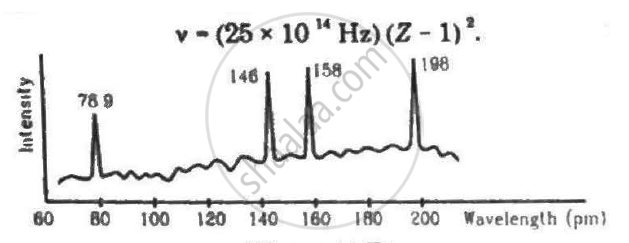
Continuous X-rays are made to strike a tissue paper soaked with polluted water. The incoming X-rays excite the atoms of the sample by knocking out the electrons from the inner shells. Characteristic X-rays are analysed and the intensity is plotted against the wavelength. Assuming that only Kα intensities are detected, list the elements present in the sample from the plot. Use Moseley's equation v − (25 × 1014Hz)(Z − 1)2.
(Use Planck constant h = 6.63 × 10⁻³⁴ Js= 4.14 × 10⁻¹⁵ eVs, speed of light c = 3 × 10⁸ m/s.)
Give one use of electromagnetic radiation in Ultraviolet radiation.
Give one use of electromagnetic radiations in Infrared radiation.
Name the radiations used for the detection of fracture in bones.
Answer briefly.
Give two uses of radio waves.
The fundamental frequency of an open organ pipe is 300 Hz. The first overtone of this pipe has same frequency as first overtone of a closed organ pipe. If speed of sound is 330 m/s, then the length of closed organ pipe is:
The frequency of x-rays, y-rays and ultraviolet rays are respectively a, b and c. Then:-
Which one of the following electromagnetic radiation has the least wavelength?
Identify the part of the electromagnetic spectrum which:
- produces the heating effect.
- is absorbed by the ozone layer in the atmosphere.
- is used for studying crystal structure.
Write any one method of the production of each of the above radiations.
Which part of the electromagnetic spectrum can the human eye detect?
Which set lists uses of ultraviolet rays?
