Advertisements
Advertisements
प्रश्न
In a Coolidge tube, electrons strike the target and stop inside it. Does the target get more and more negatively charged as time passes?
Advertisements
उत्तर
An electron emitted from the filament undergoes a number of collisions inside the material and loses its kinetic energy before coming to rest. This energy is utilised to give out photons or eject electrons from the atoms of the target. These electrons move to the battery connected to the circuit. Thus, the target does not get more and more negatively charged as time passes.
APPEARS IN
संबंधित प्रश्न
A wave has a wavelength of 10-3 nm. Name the wave.
What is the range of the wavelength of the following electromagnetic waves?
(a)X-rays,
What is the range of the wavelength of the following electromagnetic waves?
(a) Micro waves .
Name the radiations of wavelength just longer than 8 × 10⁻⁷m.
Name the rays or waves of highest frequency .
X-ray and visible light travel at the same speed in vacuum. Do they travel at the same speed in glass?
The energy of a photon of a characteristic X-ray from a Coolidge tube comes from
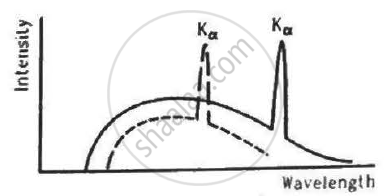
The figure shows the intensity-wavelength relations of X-rays coming from two different Coolidge tubes. The solid curve represents the relation for the tube A in which the potential difference between the target and the filament is VA and the atomic number of the target material is ZA. These quantities are VB and ZB for the other tube. Then,
Find the energy, the frequency and the momentum of an X-ray photon of wavelength 0.10 nm.
(Use Planck constant h = 4.14 × 10⁻¹⁵ eVs, speed of light c = 3 × 10⁸ m/s.)
What potential difference should be applied across an X-ray tube to get X-ray of wavelength not less than 0.10 nm? What is the maximum energy of a photon of this X-ray in joule?
(Use Planck constant h = 6.63 × 10⁻³⁴ Js= 4.14 × 10⁻¹⁵ eVs, speed of light c = 3 × 10⁸ m/s.)
Name the scientist who discovered radio waves
Name the scientist who discovered Ultraviolet rays
Name the part of the electromagnetic spectrum which is:
Produced by bombarding a metal target with high electrons.
Name two sources of ultraviolet radiation.
Give one use of electromagnetic radiations in Infrared radiation.
Answer briefly.
Give two uses of radio waves.
If λv, λx and λm Am represents the wavelength of visible light, x-ray and microwaves respectively, then ______.
One requires 11eV of energy to dissociate a carbon monoxide molecule into carbon and oxygen atoms. The minimum frequency of the appropriate electromagnetic radiation to achieve the dissociation lies in ______.
Write two uses of the following radiation.
X-rays
Where do ultraviolet rays lie relative to visible light?
