Advertisements
Advertisements
प्रश्न
The Kα X-rays of aluminium (Z = 13) and zinc (Z = 30) have wavelengths 887 pm and 146 pm respectively. Use Moseley's law √v = a(Z − b) to find the wavelengths of the Kα X-ray of iron (Z = 26).
(Use Planck constant h = 6.63 × 10⁻³⁴ Js= 4.14 × 10⁻¹⁵ eVs, speed of light c = 3 × 10⁸ m/s.)
Advertisements
उत्तर
Given:
Wavelength of Kα X-rays of aluminium, λ1 = 887 pm
Frequency of X-rays of aluminium is given by `nu_a = c/lambda`
`nu_a = (3 xx 10^8)/(887 xx 10^-12)`
`nu_a = 3.382 xx 10^17`
`nu_a = 33.82 xx 10^16 "Hz"`
Wavelength of Kα X-rays of zinc, `lambda_2`= 146 pm
Frequency of X-rays of zinc is given by
`nu_z = (3 xx 10^8)/(146 xx 10^-12)`
`nu_z = 0.02055 xx 10^20`
`nu_z = 2.055 xx 10^18 "Hz"`
We know
`sqrt(nu) = a(Z-b)`
For aluminium,
`5.815 xx 10^8 = a(13 - b) ...(1)`
For zinc,
`1.4331 xx 10^9 = a(30-b) ...(2)`
Dividing (1) by (2)
`(13 - b)/(30 - b) = (5.815 xx 10^-1)/1.4331`
= 0.4057
`⇒ 30 xx 0.4057 - 0.4057 b = 13 - b`
`⇒ 12.171 - 0.4057 b + b = 13`
`b = 0.829/0.5943 = 1.39491`
`a = (5.815 xx 10^8)/11.33`
`= 0.51323 xx 10^8 = 5 xx 10^7`
For Fe,
Frequency (`nu^'`) is given by
`nu^'` = 5× 10⁷ (26 − 1.39)
= 5 × 24.61 × 107
= 123.05 × 10⁷
`nu^' = c/lambda`
Here, c = speed of light
`lambda` = Wavelength of light
`therefore c/lambda = 5141.3 xx 10^14`
`⇒ lambda = (3 xx 10^8)/(5141.3 xx 10^14)`
`= 0.000198 xx 10^-5 "m"`
`= 198 xx 10^-12 = 198 "pm"`
APPEARS IN
संबंधित प्रश्न
To which part of the electromagnetic spectrum does a wave of frequency 5 × 10¹⁹ Hz belong?
If the earth did not have an atmosphere, would its average surface temperature be higher or lower than what it is now?
Give one use of gamma rays.
X-ray and visible light travel at the same speed in vacuum. Do they travel at the same speed in glass?
One of the following wavelengths is absent and the rest are present in the X-rays coming from a Coolidge tube. Which one is the absent wavelength?
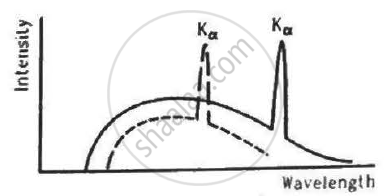
The figure shows the intensity-wavelength relations of X-rays coming from two different Coolidge tubes. The solid curve represents the relation for the tube A in which the potential difference between the target and the filament is VA and the atomic number of the target material is ZA. These quantities are VB and ZB for the other tube. Then,
Calculate the shortest wavelength of electromagnetic radiation present in Balmer series of hydrogen spectrum.
Identify the part of the electromagnetic spectrum used in (i) radar and (ii) eye surgery. Write their frequency range.
Give one use of electromagnetic radiations in Infrared radiation.
An electron beam is accelerated by a potential difference V to hit a metallic target to produce X-rays. It produces continuous as well as characteristic X-rays. If λmin is the smallest possible wavelength of X-ray in the spectrum, the variation of log λmin with log V is correctly represented in:
The frequency of x-rays, y-rays and ultraviolet rays are respectively a, b and c. Then:-
One requires 11eV of energy to dissociate a carbon monoxide molecule into carbon and oxygen atoms. The minimum frequency of the appropriate electromagnetic radiation to achieve the dissociation lies in ______.
Write two uses of the following radiation.
X-rays
What do electromagnetic waves require for propagation?
Which devices commonly produce microwaves?
Which set lists uses of microwaves?
Where does infrared radiation lie relative to visible light?
How does the frequency of violet light compare with that of red light?
How do ultraviolet rays compare with visible light?
