Advertisements
Advertisements
प्रश्न
Give a reason for the following:
Long-distance radio broadcasts use short-wave bands. Why?
Advertisements
उत्तर
Long distance radio broadcasts use shortwave bands because only these bands can be refracted by the ionosphere.
संबंधित प्रश्न
If the earth did not have atmosphere, would its average surface temperature be higher or lower than what it is now? Explain.
To which part of the electromagnetic spectrum does a wave of frequency 5 × 10¹¹ Hz belong?
The small ozone layer on top of the stratosphere is crucial for human survival. Why?
Name the high energetic invisible electromagnetic waves which help in the study of the structure of crystals
The wavelengths for the light of red and blue colours are roughly 7.8 × `10^7` m and 4.8 × `10^7` m respectively.
(a) Which colour has the greater speed in vacuum?
(b) Which colour has the greater speed in glass?
Name the subjective property of light related to its wavelength.
What is the range of the wavelength of the following electromagnetic waves?
(a) Micro waves .
Name the waves of wavelength nearly 0.1 nm.
In a Coolidge tube, electrons strike the target and stop inside it. Does the target get more and more negatively charged as time passes?
X-ray and visible light travel at the same speed in vacuum. Do they travel at the same speed in glass?
Characteristic X-rays may be used to identify the element from which they are being emitted. Can continuous X-rays be used for this purpose?
X-ray from a Coolidge tube is incident on a thin aluminium foil. The intensity of the X-ray transmitted by the foil is found to be I0. The heating current is increased to increase the temperature of the filament. The intensity of the X-ray transmitted by the foil will be
(a) zero
(b) < I0
(c) I0
(d) > I0
Visible light passing through a circular hole forms a diffraction disc of radius 0.1 mm on a screen. If an X-ray is passed through the same setup, the radius of the diffraction disc will be
The Kα X-rays of aluminium (Z = 13) and zinc (Z = 30) have wavelengths 887 pm and 146 pm respectively. Use Moseley's law √v = a(Z − b) to find the wavelengths of the Kα X-ray of iron (Z = 26).
(Use Planck constant h = 6.63 × 10⁻³⁴ Js= 4.14 × 10⁻¹⁵ eVs, speed of light c = 3 × 10⁸ m/s.)
The wavelengths of Kα and Lα X-rays of a material are 21.3 pm and 141 pm respectively. Find the wavelength of Kβ X-ray of the material.
(Use Planck constant h = 6.63 × 10⁻³⁴ Js= 4.14 × 10⁻¹⁵ eVs, speed of light c = 3 × 10⁸ m/s.)
The distance between the cathode (filament) and the target in an X-ray tube is 1.5 m. If the cutoff wavelength is 30 pm, find the electric field between the cathode and the target.
(Use Planck constant h = 6.63 × 10⁻³⁴ Js= 4.14 × 10⁻¹⁵ eVs, speed of light c = 3 × 10⁸ m/s.)
The short-wavelength limit shifts by 26 pm when the operating voltage in an X-ray tube is increased to 1.5 times the original value. What was the original value of the operating voltage?
(Use Planck constant h = 6.63 × 10⁻³⁴ Js= 4.14 × 10⁻¹⁵ eVs, speed of light c = 3 × 10⁸ m/s.)
The electron beam in a colour TV is accelerated through 32 kV and then strikes the screen. What is the wavelength of the most energetic X-ray photon?
(Use Planck constant h = 6.63 × 10⁻³⁴ Js= 4.14 × 10⁻¹⁵ eVs, speed of light c = 3 × 10⁸ m/s.)
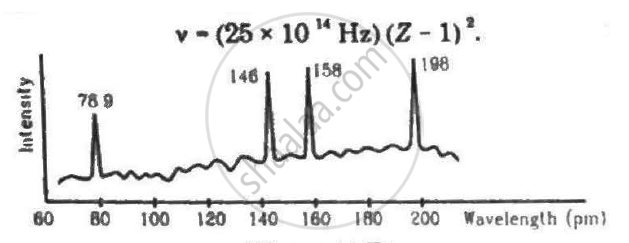
Continuous X-rays are made to strike a tissue paper soaked with polluted water. The incoming X-rays excite the atoms of the sample by knocking out the electrons from the inner shells. Characteristic X-rays are analysed and the intensity is plotted against the wavelength. Assuming that only Kα intensities are detected, list the elements present in the sample from the plot. Use Moseley's equation v − (25 × 1014Hz)(Z − 1)2.
(Use Planck constant h = 6.63 × 10⁻³⁴ Js= 4.14 × 10⁻¹⁵ eVs, speed of light c = 3 × 10⁸ m/s.)
Name the scientist who discovered
X-rays
Name the scientist who discovered Ultraviolet rays
| Gamma rays | D | C | Visible light | B | A |
The above table shows different parts of the electromagnetic spectrum.
(a) Identify the parts of the spectrum marked as A, B, C and D.
(b) Which of the radiations A or B has the higher frequency?
(c) State two properties which are common to all parts of the electromagnetic spectrum.
(d) Name one source of each of the radiation of electromagnetic spectrum.
(e) Name one detector for each of the radiation.
(f) Name one use of each of the radiation.
Name the part of the electromagnetic spectrum which is:
Produced by bombarding a metal target with high electrons.
Calculate the shortest wavelength of electromagnetic radiation present in Balmer series of hydrogen spectrum.
Choose the correct option.
How does the frequency of a beam of ultraviolet light change when it travels from air into glass?
Answer briefly.
Does an ordinary electric lamp emit EM waves?
Answer briefly.
Why light waves travel in a vacuum whereas sound waves cannot?
Answer briefly.
Give two uses of ultraviolet rays.
Answer briefly.
Name the most harmful radiation entering the Earth's atmosphere from outer space.
Answer briefly.
What is a carrier wave?
Solve the numerical problem.
Calculate the frequency in MHz of a radio wave of wavelength 250 m. Remember that the speed of all EM waves in a vacuum is 3.0 × 10⁸ m/s.
A bat moving at 10 ms−1 towards a wall sends a sound signal of 8000 Hz towards it. On reflection, it hears a sound of frequency f The value of f in Hz is close to (speed of sound = 320 ms−1)
An electron beam is accelerated by a potential difference V to hit a metallic target to produce X-rays. It produces continuous as well as characteristic X-rays. If λmin is the smallest possible wavelength of X-ray in the spectrum, the variation of log λmin with log V is correctly represented in:
The frequency of e. m waves which is best suited .to observed of radius 3 × 10⁻⁴ his of the order of
What is time period of the light for which the eye is most sensitive?
The electric field intensity produced by the radiations coming from 100 W bulb at a 3 m distance is E. The electric field intensity produced by the radiations coming from 50 W bulb at the same distance is ______.
The ratio of contributions made by the electric field and magnetic field components to the intensity of an EM wave is ______.
Electromagnetic waves with wavelength
- λ1 is used in satellite communication.
- λ2 is used to kill germs in water purifies.
- λ3 is used to detect leakage of oil in underground pipelines.
- λ4 is used to improve visibility in runways during fog and mist conditions.
- Identify and name the part of electromagnetic spectrum to which these radiations belong.
- Arrange these wavelengths in ascending order of their magnitude.
- Write one more application of each.
What happens to the intensity of light from a bulb if the distance from the bulb is doubled? As a laser beam travels across the length of a room, its intensity essentially remains constant. What geometrical characteristic of LASER beam is responsible for the constant intensity which is missing in the case of light from the bulb?
Write two uses of the following radiation.
X-rays
In uranium (Z = 92) the K absorption edge is 0.107 Å and the Kα line is 0.126 Å, and the wavelength of the L absorption edge is ______.
Given below in the left column are different modes of communication using the kinds of waves given in the right column.
| A. | Optical Fibre Communication |
P. | Ultrasound |
| B. | Radar | Q. | Infrared Light |
| C. | Sonar | R. | Microwaves |
| D. | Mobile Phones | S. | Radio Waves |
From the options given below, find the most appropriate match between entries in the left and the right column.
Identify the electromagnetic wave whose wavelength range is from about 10-3 m to about 10-1 m. Write one use of this.
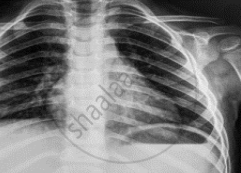
Name the electromagnetic radiation that has been used in obtaining the image below.
At what speed do all electromagnetic waves travel in a vacuum?
Which group of activities uses radio waves?
How do the wavelengths and frequencies of microwaves compare with those of radio waves?
How does the frequency of violet light compare with that of red light?
