Advertisements
Advertisements
प्रश्न
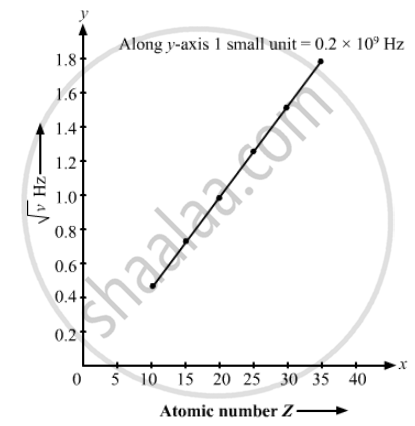
The Kβ X-rays from certain elements are given below. Draw a Moseley-type plot of √v versus Z for Kβ radiation.
| Element | Ne | P | Ca | Mn | Zn | Br |
| Energy (keV) | 0.858 | 2.14 | 4.02 | 6.51 | 9.57 | 13.3 |
Advertisements
उत्तर
We can directly get value of v by energy frequency relation.
hv = energy
Here, h = Planck's constant
`v = "Energy (in keV)"/h`
The required graph is as follows :
APPEARS IN
संबंधित प्रश्न
What role dose infra-red radiation play in maintain the Earth’s warmth
If the earth did not have atmosphere, would its average surface temperature be higher or lower than what it is now? Explain.
Give a reason for the following:
Long-distance radio broadcasts use short-wave bands. Why?
State Moseley's law
(a) Give a list of at least five radiations, in order of their increasing frequencies, which make up the complete electromagnetic spectrum.
(b) Which of the radiation mentioned by you in part (a) has the highest penetrating power.
Give the range of wavelength of the electromagnetic waves visible to us.
Name the waves used for taking photographs in dark.
How are X-rays produced?
Cutoff wavelength of X-rays coming from a Coolidge tube depends on the
(a) target material
(b) accelerating voltage
(c) separation between the target and the filament
(d) temperature of the filament.
A certain element emits Kα X-ray of energy 3.69 keV. Use the data from the previous problem to identify the element.
(Use Planck constant h = 6.63 × 10⁻³⁴ Js= 4.14 × 10⁻¹⁵ eVs, speed of light c = 3 × 10⁸ m/s.)
The energy of a silver atom with a vacancy in K shell is 25.31 keV, in L shell is 3.56 keV and in M shell is 0.530 keV higher than the energy of the atom with no vacancy. Find the frequency of Kα, Kβ and Lα X-rays of silver.
(Use Planck constant h = 6.63 × 10⁻³⁴ Js= 4.14 × 10⁻¹⁵ eVs, speed of light c = 3 × 10⁸ m/s.)
A free atom of iron emits Kα X-rays of energy 6.4 keV. Calculate the recoil kinetic energy of the atom. Mass of an iron atom = 9.3 × 10⁻²⁶ kg.
(Use Planck constant h = 6.63 × 10⁻³⁴ Js= 4.14 × 10⁻¹⁵ eVs, speed of light c = 3 × 10⁸ m/s.)
Name the part of the electromagnetic spectrum which is:
Produced by bombarding a metal target with high electrons.
State two uses of infrared radiations.
Answer briefly.
Name the most harmful radiation entering the Earth's atmosphere from outer space.
Microwaves are electromagnetic waves with frequency in the range of.
In an atom X, electrons absorb the energy from an external source. This energy “excites” the electrons from a lower-energy level to a higher-energy level around the nucleus of the atom. When electrons return to the ground state, they emit photons.
The figure below is the energy level diagram of atom X with three energy levels, E1 = 0.00eV, E2 = 1.78eV and E3 = 2.95eV. The ground state is considered 0 eV for reference. The transition of electrons takes place between levels E1 and E2.

- What wavelength of radiation is needed to excite the atom to energy level E2 from E1?
- Suppose the external source has a power of 100 W. What would be the rate of photon emission?
Which group of activities uses radio waves?
Which set consists of applications of infrared radiation?
Which set lists applications of X-rays?
