Advertisements
Advertisements
प्रश्न
Name two electromagnetic waves of wavelength smaller than that of violet light.
Advertisements
उत्तर
Gamma rays (y-rays) and X-rays.
APPEARS IN
संबंधित प्रश्न
Name the rays or waves of highest frequency .
Why is exposure to X-rays injurious to health but not exposure to visible light, when both are electromagnetic waves?
For a given material, the energy and wavelength of characteristic X-rays satisfy
(a) E(Kα) > E(Kβ) > E(Kγ)
(b) E(Mα) > E(Lα) > E(Kα)
(c) λ(Kα) > λ(Kβ) > λ(Kγ)
(d) λ(Mα) > λ(Lα) > λ(Kα).
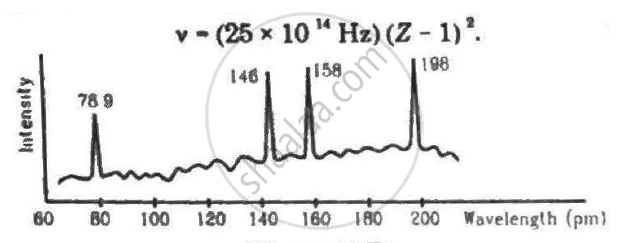
Continuous X-rays are made to strike a tissue paper soaked with polluted water. The incoming X-rays excite the atoms of the sample by knocking out the electrons from the inner shells. Characteristic X-rays are analysed and the intensity is plotted against the wavelength. Assuming that only Kα intensities are detected, list the elements present in the sample from the plot. Use Moseley's equation v − (25 × 1014Hz)(Z − 1)2.
(Use Planck constant h = 6.63 × 10⁻³⁴ Js= 4.14 × 10⁻¹⁵ eVs, speed of light c = 3 × 10⁸ m/s.)
Name three radiations and their wavelength range which are invisible and beyond the violet end of the visible spectrum.
An e.m. wave exerts pressure on the surface on which it is incident. Justify.
Which of the following is a tool used for separating the different color wavelengths from each other?
The ratio of contributions made by the electric field and magnetic field components to the intensity of an EM wave is ______.
At what speed do all electromagnetic waves travel in a vacuum?
Which set lists uses of microwaves?
