Advertisements
Advertisements
प्रश्न
Iron emits Kα X-ray of energy 6.4 keV. Calculate the times taken by an iron Kα photon to cross through a distance of 3 km.
(Use Planck constant h = 4.14 × 10⁻¹⁵ eVs, speed of light c = 3 × 10⁸ m/s.)
Advertisements
उत्तर
Given:
Energy of the X-ray, E = 6.4 keV
Distance travelled by the photon, d = 3 km = 3 `xx ` 103 m
Time taken by the photon to cross the distance of 3 km is given by
`t = "Distance"/"Speed" = (3 xx 10^3)/(3 xx 10^8)`
`t = 10^-5 "s" = 10 xx 10^-6 "s"`
`t = 10 mus`
Both the Kα photon and X-ray will take the same time, that is, 10 μs , to cross the distance of 3 km.
APPEARS IN
संबंधित प्रश्न
Name the high energetic invisible electromagnetic waves which help in the study of the structure of crystals
Why are infra-red waves often called heat waves? Explain.
Arrange the following radiations in the order of their increasing wavelength:
X-rays, infrared rays, ratio waves, gamma ray and microwaves.
What is the range of the wavelength of the following electromagnetic waves?
(a) Ultraviolet
Name the waves produced by the changes in the nucleus of an atom.
Can X-rays be used for photoelectric effect?
Frequencies of Kα X-rays of different materials are measured. Which one of the graphs in the figure may represent the relation between the frequency v and the atomic number Z ?
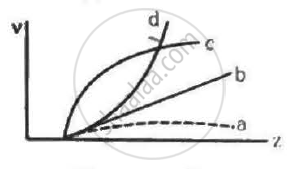
The Kβ X-ray of argon has a wavelength of 0.36 nm. The minimum energy needed to ionize an argon atom is 16 eV. Find the energy needed to knock out an electron from the K shell of an argon atom.
How will you investigate the existence of the radiation beyond the red and violet extremes of the spectrum?
Name two sources of infrared radiation.
Choose the correct option.
How does the frequency of a beam of ultraviolet light change when it travels from air into glass?
If the Earth did not have atmosphere, would its average surface temperature be higher or lower than what it is now? Explain.
Find the photon energy in units of ev for electromagnetic wave if waves length 40 m. Given h = 6.63 × 10⁻³⁴ J.
A radio can tune to any station in the 7.5 mHz to 12 MHz band. What is corresponding wave length band.
All components of the electromagnetic spectrum in a vacuum have the same ______
Identify the part of the electromagnetic spectrum which:
- produces the heating effect.
- is absorbed by the ozone layer in the atmosphere.
- is used for studying crystal structure.
Write any one method of the production of each of the above radiations.
Below is an incomplete table showing the arrangement of electromagnetic spectrum in the increasing order of their wavelength. Complete the table:
| Gamma ray | X - ray | UV rays | Visible rays | Infrared | A | Radio waves |
- Identify the radiation A.
- Name the radiation used to detect fracture in bones.
- Name one property common to both A and Radio waves.
Name one radiation having the wavelength longer than the wavelength of these radiations.
In \[c = \nu\lambda\], what do \[c\], \[\nu\], and \[\lambda\] represent?
Which group of activities uses radio waves?
