Advertisements
Advertisements
प्रश्न
Iron emits Kα X-ray of energy 6.4 keV. Calculate the times taken by an iron Kα photon to cross through a distance of 3 km.
(Use Planck constant h = 4.14 × 10⁻¹⁵ eVs, speed of light c = 3 × 10⁸ m/s.)
Advertisements
उत्तर
Given:
Energy of the X-ray, E = 6.4 keV
Distance travelled by the photon, d = 3 km = 3 `xx ` 103 m
Time taken by the photon to cross the distance of 3 km is given by
`t = "Distance"/"Speed" = (3 xx 10^3)/(3 xx 10^8)`
`t = 10^-5 "s" = 10 xx 10^-6 "s"`
`t = 10 mus`
Both the Kα photon and X-ray will take the same time, that is, 10 μs , to cross the distance of 3 km.
APPEARS IN
संबंधित प्रश्न
To which part of the electromagnetic spectrum does a wave of frequency 5 × 10¹¹ Hz belong?
Why are infra-red waves often called heat waves? Explain.
What do you understand by the invisible spectrum?
Name the radiations of wavelength just longer than 8 × 10⁻⁷m.
Name the radiations of wavelength shorter than 4 × 10⁻⁷ m.
Give one use of gamma rays.
How are X-rays produced?
In a Coolidge tube, electrons strike the target and stop inside it. Does the target get more and more negatively charged as time passes?
X-ray and visible light travel at the same speed in vacuum. Do they travel at the same speed in glass?
Can Lα X-ray of one material have shorter wavelength than Kα X-ray of another?
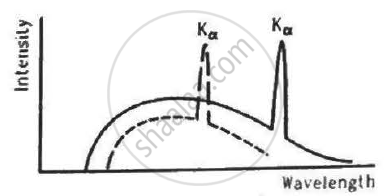
The figure shows the intensity-wavelength relations of X-rays coming from two different Coolidge tubes. The solid curve represents the relation for the tube A in which the potential difference between the target and the filament is VA and the atomic number of the target material is ZA. These quantities are VB and ZB for the other tube. Then,
Write the range of the wavelength of the following electromagnetic radiations:
(a) Infrared rays
(b) Ultraviolet rays
(c) γ -rays
Write one use of each of the above.
Arrange the following electromagnetic waves in increasing order of their frequencies (i.e. begin with the lowest frequency):
Visible light, y rays, X rays, microwaves, radio waves, infrared radiations, and ultraviolet radiation.
Answer briefly.
Give two uses of ultraviolet rays.
Which is the correct ascending order of wavelengths?
Which one of the following electromagnetic radiation has the least wavelength?
Assertion (A): Ultraviolet radiations is scattered more as compared to the microwave radiations.
Reason (R): Wavelength of ultraviolet radiation is more than the wavelength of microwave radiation.
Below is an incomplete table showing the arrangement of electromagnetic spectrum in the increasing order of their wavelength. Complete the table:
| Gamma ray | X - ray | UV rays | Visible rays | Infrared | A | Radio waves |
- Identify the radiation A.
- Name the radiation used to detect fracture in bones.
- Name one property common to both A and Radio waves.
Which relation connects the speed of light in vacuum, frequency, and wavelength?
Which devices commonly produce microwaves?
