Advertisements
Advertisements
Question
Iron emits Kα X-ray of energy 6.4 keV. Calculate the times taken by an iron Kα photon to cross through a distance of 3 km.
(Use Planck constant h = 4.14 × 10⁻¹⁵ eVs, speed of light c = 3 × 10⁸ m/s.)
Advertisements
Solution
Given:
Energy of the X-ray, E = 6.4 keV
Distance travelled by the photon, d = 3 km = 3 `xx ` 103 m
Time taken by the photon to cross the distance of 3 km is given by
`t = "Distance"/"Speed" = (3 xx 10^3)/(3 xx 10^8)`
`t = 10^-5 "s" = 10 xx 10^-6 "s"`
`t = 10 mus`
Both the Kα photon and X-ray will take the same time, that is, 10 μs , to cross the distance of 3 km.
APPEARS IN
RELATED QUESTIONS
If the earth did not have atmosphere, would its average surface temperature be higher or lower than what it is now? Explain.
What physical quantity is the same for X-rays of wavelength 10−10 m, red light of wavelength 6800 Å and radiowaves of wavelength 500 m?
Name the rays or waves of highest frequency .
Can X-rays be polarised?
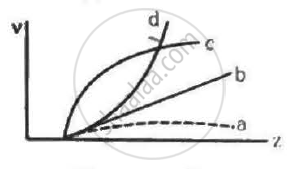
Frequencies of Kα X-rays of different materials are measured. Which one of the graphs in the figure may represent the relation between the frequency v and the atomic number Z ?
X-ray from a Coolidge tube is incident on a thin aluminium foil. The intensity of the X-ray transmitted by the foil is found to be I0. The heating current is increased to increase the temperature of the filament. The intensity of the X-ray transmitted by the foil will be
(a) zero
(b) < I0
(c) I0
(d) > I0
Find the energy, the frequency and the momentum of an X-ray photon of wavelength 0.10 nm.
(Use Planck constant h = 4.14 × 10⁻¹⁵ eVs, speed of light c = 3 × 10⁸ m/s.)
The short-wavelength limit shifts by 26 pm when the operating voltage in an X-ray tube is increased to 1.5 times the original value. What was the original value of the operating voltage?
(Use Planck constant h = 6.63 × 10⁻³⁴ Js= 4.14 × 10⁻¹⁵ eVs, speed of light c = 3 × 10⁸ m/s.)
Name the scientist who discovered Microwaves
Name two sources of infrared radiation.
Answer briefly.
Give two uses of radio waves.
Answer briefly.
What is a carrier wave?
Solve the numerical problem.
Calculate the frequency in MHz of a radio wave of wavelength 250 m. Remember that the speed of all EM waves in a vacuum is 3.0 × 10⁸ m/s.
A car is moving towards a high cliff. The car driver sounds a horn of frequency f. The reflected sound heard by the driver has a frequency 2f. If v be the velocity of sound, then the velocity of the car, in the same velocity units, will be:
A radio can tune to any station in the 7.5 mHz to 12 MHz band. What is corresponding wave length band.
What is time period of the light for which the eye is most sensitive?
One requires 11eV of energy to dissociate a carbon monoxide molecule into carbon and oxygen atoms. The minimum frequency of the appropriate electromagnetic radiation to achieve the dissociation lies in ______.
Given below in the left column are different modes of communication using the kinds of waves given in the right column.
| A. | Optical Fibre Communication |
P. | Ultrasound |
| B. | Radar | Q. | Infrared Light |
| C. | Sonar | R. | Microwaves |
| D. | Mobile Phones | S. | Radio Waves |
From the options given below, find the most appropriate match between entries in the left and the right column.
Which description identifies how radio waves are mainly produced?
