Advertisements
Advertisements
Question
Answer briefly.
Why are microwaves used in radar?
Advertisements
Solution
Microwaves are used in radar systems for identifying the location of distant objects like ships, airplanes, etc.
APPEARS IN
RELATED QUESTIONS
Name the parts of the electromagnetic spectrum which is
used as a diagnostic tool in medicine.
Write in brief, how these waves can be produced.
Optical and radio telescopes are built on the ground but X-ray astronomy is possible only from satellites orbiting the earth. Why?
What is the range of the wavelength of the following electromagnetic waves?
(a) Visible.
What are ultraviolet radiations?
How are X-rays produced?
Which part of electromagnetic spectrum is used in radar systems?
Can X-rays be used for photoelectric effect?
Can Lα X-ray of one material have shorter wavelength than Kα X-ray of another?
Why is exposure to X-rays injurious to health but not exposure to visible light, when both are electromagnetic waves?
50% of the X-ray coming from a Coolidge tube is able to pass through a 0.1 mm thick aluminium foil. The potential difference between the target and the filament is increased. The thickness of the aluminium foil that will allow 50% of the X-ray to pass through will be
The electric current in an X-ray tube (from the target to the filament) operating at 40 kV is 10 mA. Assume that on an average, 1% of the total kinetic energy of the electron hitting hte target are converted into X-rays.
(a) What is the total power emitted as X-rays and (b) how much heat is produced in the target every second?
Suppose a monochromatic X-ray beam of wavelength 100 pm is sent through a Young's double slit and the interference pattern is observed on a photographic plate placed 40 cm away from the slit. What should be the separation between the slits so that the successive maxima on the screen are separated by a distance of 0.1 mm?
Name the scientist who discovered Ultraviolet rays
Name the part of the electromagnetic spectrum which is:
Suitable for radar systems used in aircraft navigation.
Name the radiations used for the detection of fracture in bones.
What is the wavelength of the wave whose frequency is 1012 Hz? Name the electromagnetic wave.
Answer briefly.
Why light waves travel in a vacuum whereas sound waves cannot?
The ozone layer absorbs
If λv, λx and λm Am represents the wavelength of visible light, x-ray and microwaves respectively, then ______.
All components of the electromagnetic spectrum in a vacuum have the same ______
One requires 11eV of energy to dissociate a carbon monoxide molecule into carbon and oxygen atoms. The minimum frequency of the appropriate electromagnetic radiation to achieve the dissociation lies in ______.
In uranium (Z = 92) the K absorption edge is 0.107 Å and the Kα line is 0.126 Å, and the wavelength of the L absorption edge is ______.
Given below in the left column are different modes of communication using the kinds of waves given in the right column.
| A. | Optical Fibre Communication |
P. | Ultrasound |
| B. | Radar | Q. | Infrared Light |
| C. | Sonar | R. | Microwaves |
| D. | Mobile Phones | S. | Radio Waves |
From the options given below, find the most appropriate match between entries in the left and the right column.
Assertion (A): Ultraviolet radiations is scattered more as compared to the microwave radiations.
Reason (R): Wavelength of ultraviolet radiation is more than the wavelength of microwave radiation.
What is the speed of radio waves in vacuum?
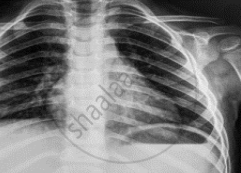
Name the electromagnetic radiation that has been used in obtaining the image below.
What happens to wavelength as the frequency of electromagnetic radiation increases?
Which devices commonly produce microwaves?
