Advertisements
Advertisements
Question
Choose the correct option.
Earth’s atmosphere is richest in
Options
UV
IR
X-ray
Microwaves
Advertisements
Solution
Earth’s atmosphere is richest in IR
APPEARS IN
RELATED QUESTIONS
Name the parts of the electromagnetic spectrum which is
used to treat muscular strain.
Write in brief, how these waves can be produced.
A radio can tune in to any station in the 7.5 MHz to 12 MHz band. What is the corresponding wavelength band?
What do you understand by the statement, "Electromagnetic waves transport momentum"?
Which radiation is used for satellite communication?
What is the range of the wavelength of the following electromagnetic waves?
(A) Radio waves.
State the approximate range of wavelength associated with infrared rays.
Name the radiations of wavelength shorter than 4 × 10⁻⁷ m.
Which part of electromagnetic spectrum is used in radar systems?
Can Lα X-ray of one material have shorter wavelength than Kα X-ray of another?
Can a hydrogen atom emit characteristic X-rays?
The figure shows the intensity-wavelength relations of X-rays coming from two different Coolidge tubes. The solid curve represents the relation for the tube A in which the potential difference between the target and the filament is VA and the atomic number of the target material is ZA. These quantities are VB and ZB for the other tube. Then,
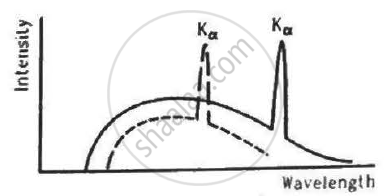
The Kβ X-ray of argon has a wavelength of 0.36 nm. The minimum energy needed to ionize an argon atom is 16 eV. Find the energy needed to knock out an electron from the K shell of an argon atom.
Name the scientist who discovered Microwaves
Name the scientist who discovered Infra-red waves
Name the radiations used for the detection of fracture in bones.
Answer briefly.
Give two uses of radio waves.
Solve the numerical problem.
The speed of light is 3 × 10⁸ m/s. Calculate the frequency of red light of a wavelength of 6.5 × 10⁻⁷ m.
If the Earth did not have atmosphere, would its average surface temperature be higher or lower than what it is now? Explain.
An e.m. wave exerts pressure on the surface on which it is incident. Justify.
A car is moving towards a high cliff. The car driver sounds a horn of frequency f. The reflected sound heard by the driver has a frequency 2f. If v be the velocity of sound, then the velocity of the car, in the same velocity units, will be:
Microwaves are electromagnetic waves with frequency in the range of.
A radio can tune to any station in the 7.5 mHz to 12 MHz band. What is corresponding wave length band.
What is the wavelength range of electromagnetic radiation used in radio broadcast?
What happens to wavelength as the frequency of electromagnetic radiation increases?
Which set lists uses of microwaves?
Which set consists of applications of infrared radiation?
How do ultraviolet rays compare with visible light?
Which properties characterize X-rays?
How are X-rays commonly produced?
