Advertisements
Advertisements
Question
Find the energy, the frequency and the momentum of an X-ray photon of wavelength 0.10 nm.
(Use Planck constant h = 4.14 × 10⁻¹⁵ eVs, speed of light c = 3 × 10⁸ m/s.)
Advertisements
Solution
Given:
Wavelength of the X-ray photon, λ = 0.1 nm
Speed of light, c = 3 `xx` 108 m/s
(a) Energy of the photon (E) is given by
`E = (hc)/lambda`
⇒ `E = (1242 "eV")/0.1`
⇒ `E = 12420 "eV"`
⇒ `E = 12.42 "keV" ≈ 12.4 "keV"`
(b) Frequency is given by
`v = c/lambda`
⇒`v = (3 xx 10^8)/(0.1 xx 10^-9)`
⇒`v = 3 xx 10^18 "Hz"`
(c) Momentum of the photon (P) is given by
`P = E/c`
⇒`P = (12.4 xx 10^3 xx 1.6 xx 10^-19)/(3 xx 10^8)`
⇒`P = 6.613 xx 10^-24 "kg-m/s" ≈ 6.62 xx 10^-24 "g-m/s"`
APPEARS IN
RELATED QUESTIONS
To which part of electromagnetic spectrum does a wave of frequency 3 × 10¹³ Hz belong?
What physical quantity is the same for X-rays of wavelength 10−10 m, red light of wavelength 6800 Å and radiowaves of wavelength 500 m?
Use the formula λm T= 0.29 cm K to obtain the characteristic temperature ranges for different parts of the electromagnetic spectrum. What do the numbers that you obtain tell you?
Give a reason for the following:
Long-distance radio broadcasts use short-wave bands. Why?
Give a reason for the following:
It is necessary to use satellites for long-distance TV transmission. Why?
What is the range of the wavelength of the following electromagnetic waves?
(a)X-rays,
What is the range of the wavelength of the following electromagnetic waves?
(a) Ultraviolet
Give one use of microwaves.
Name three properties of ultraviolet radiations which are similar to visible light.
An electromagnetic wave has a frequency of 500 MHz and a wavelength of 60 cm.name the medium through which it is travelling
The energy of a photon of a characteristic X-ray from a Coolidge tube comes from
If the current in the circuit for heating the filament is increased, the cutoff wavelength
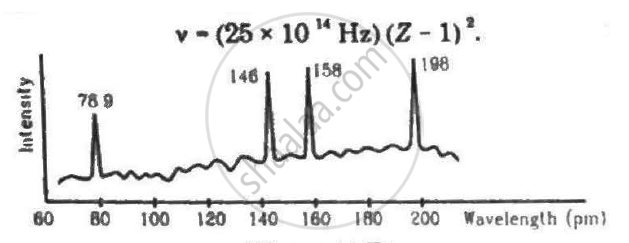
Continuous X-rays are made to strike a tissue paper soaked with polluted water. The incoming X-rays excite the atoms of the sample by knocking out the electrons from the inner shells. Characteristic X-rays are analysed and the intensity is plotted against the wavelength. Assuming that only Kα intensities are detected, list the elements present in the sample from the plot. Use Moseley's equation v − (25 × 1014Hz)(Z − 1)2.
(Use Planck constant h = 6.63 × 10⁻³⁴ Js= 4.14 × 10⁻¹⁵ eVs, speed of light c = 3 × 10⁸ m/s.)
State the name and the range of wavelength of the invisible electromagnetic waves beyond the red end of the visible spectrum.
Calculate the shortest wavelength of electromagnetic radiation present in Balmer series of hydrogen spectrum.
Give one use of electromagnetic radiations in Infrared radiation.
X-rays, gamma rays and microwaves travelling in a vacuum have ______.
Arrange the following electromagnetic radiation in the ascending order of their frequencies:
X-rays, microwaves, gamma rays, radio waves
Which set lists uses of ultraviolet rays?
