Advertisements
Advertisements
Question
The potential difference applied to an X-ray tube is increased. As a result, in the emitted radiation,
(a) the intensity increases
(b) the minimum wavelength increases
(c) the intensity remains unchanged
(d) the minimum wavelength decreases.
Advertisements
Solution
(c) the intensity remains unchanged
(d) the minimum wavelength decreases
Cutoff wavelength (`λ_min`) is given by
`λ_min = (hc)/(eV)`
Here,
h = Planck's constant
c = Speed of light
V = Accelerating voltage
e = Charge of electron
If the potential difference applied to an X-ray tube (V) is increased, then the minimum wavelength (cutoff wavelength) gets decreased.
Intensity is not affected by the potential difference applied.
APPEARS IN
RELATED QUESTIONS
If the earth did not have atmosphere, would its average surface temperature be higher or lower than what it is now? Explain.
Give a reason for the following:
Long-distance radio broadcasts use short-wave bands. Why?
What is the range of the wavelength of the following electromagnetic waves?
(a) Ultraviolet
Give the range of wavelength of the electromagnetic waves visible to us.
An electromagnetic wave has a frequency of 500 MHz and a wavelength of 60 cm Calculate the velocity of the wave.
How are X-rays produced?
Can X-rays be polarised?
If the current in the circuit for heating the filament is increased, the cutoff wavelength
Heat at the rate of 200 W is produced in an X-ray tube operating at 20 kV. Find the current in the circuit. Assume that only a small fraction of the kinetic energy of electrons is converted into X-rays.
The Kα X-rays of aluminium (Z = 13) and zinc (Z = 30) have wavelengths 887 pm and 146 pm respectively. Use Moseley's law √v = a(Z − b) to find the wavelengths of the Kα X-ray of iron (Z = 26).
(Use Planck constant h = 6.63 × 10⁻³⁴ Js= 4.14 × 10⁻¹⁵ eVs, speed of light c = 3 × 10⁸ m/s.)
Two waves A and B have wavelength 0.01 Å and 9000 Å respectively.
Name the two waves. compare the speeds of these waves when they travel in vacuum.
Name three radiations and their wavelength range which are invisible and beyond the violet end of the visible spectrum.
Name any two electromagnetic waves which have a frequency higher than that of violet light. State one use of each.
X-rays, gamma rays and microwaves travelling in a vacuum have ______.
Ozone layer above the earth's atmosphere will
The ratio of contributions made by the electric field and magnetic field components to the intensity of an EM wave is ______.
Electromagnetic waves with wavelength
- λ1 is suitable for radar systems used in aircraft navigation.
- λ2 is used to kill germs in water purifiers.
- λ3 is used to improve visibility in runways during fog and mist conditions.
Identify and name the part of the electromagnetic spectrum to which these radiations belong. Also arrange these wavelengths in ascending order of their magnitude.
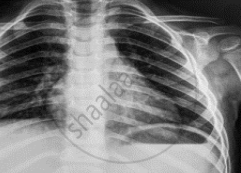
Name the electromagnetic radiation that has been used in obtaining the image below.
Which description identifies how radio waves are mainly produced?
