Advertisements
Advertisements
Question
An X-ray tube operates at 40 kV. Suppose the electron converts 70% of its energy into a photon at each collision. Find the lowest there wavelengths emitted from the tube. Neglect the energy imparted to the atom with which the electron collides.
(Use Planck constant h = 6.63 × 10⁻³⁴ Js= 4.14 × 10⁻¹⁵ eVs, speed of light c = 3 × 10⁸ m/s.)
Advertisements
Solution
Given:-
Potential of the X-ray tube, V = 40 kV = 40 × 103 V
Energy = 40 × 103 eV
Energy utilised by the electron is given by `E = 70/100 xx 40 xx 10^3 = 28 xx 10^3 "eV"`
Wavelength (`lambda`) is given by
`lambda = (hc)/E`
Here,
h = Planck's constant
c = Speed of light
E = Energy of the electron
`therefore lambda = (hc)/E`
`⇒ lambda = (1242 "eV" - "nm")/(28 xx 10^3 "eV")`
`⇒ lambda = (1242 xx 10^-9 "eV")/(28 xx 10^3 "eV")`
`⇒ lambda = 44.35 xx 10^-12`
`⇒ lambda = 44.35 "pm"`
For the second wavelength,
E = 70% (Leftover energy)
`= 70/100 xx (40-28)10^3`
`= 70/100 xx 12 xx 10^3`
`= 84 xx 10^2 "eV"`
And
`lambda = (hc)/E = 1242/(8.4 xx 10^3)`
`= 147.86 xx 10^-3 "nm"`
`= 147.86 "pm" = 148 "pm"`
For the third wavelength,
`E = 70/100(12 - 8.4) xx 10^3`
`= 7 xx 3.6 xx 10^2 = 25.2 xx 10^2 "eV"`
And ,
`lambda = (hc)/E = 1242/(25.2 xx 10^2)`
`= 49.2857 xx 10^-2`
`= 493 "pm"`
APPEARS IN
RELATED QUESTIONS
Identify the part of the electromagnetic spectrum which is:
produced by bombarding a metal target by high speed electrons.
A wave has a wavelength of 10-3 nm. Name the wave.
What is the range of the wavelength of the following electromagnetic waves?
(a)X-rays,
What do you understand by the invisible spectrum?
Characteristic X-rays may be used to identify the element from which they are being emitted. Can continuous X-rays be used for this purpose?
The X-ray beam emerging from an X-ray tube
One of the following wavelengths is absent and the rest are present in the X-rays coming from a Coolidge tube. Which one is the absent wavelength?
Mark the correct options.
(a) An atom with a vacancy has smaller energy that a neutral atom.
(b) K X-ray is emitted when a hole makes a jump from the K shell to some other shell.
(c) The wavelength of K X-ray is smaller than the wavelength of L X-ray of the same material.
(d) The wavelength of Kα X-ray is smaller than the wavelength of Kβ X-ray of the same material.
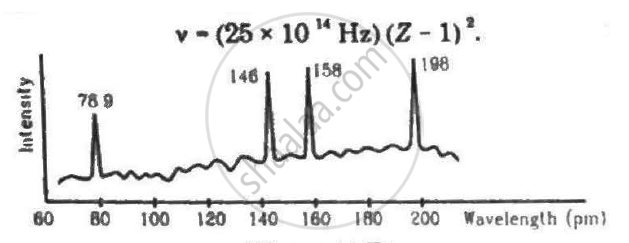
Continuous X-rays are made to strike a tissue paper soaked with polluted water. The incoming X-rays excite the atoms of the sample by knocking out the electrons from the inner shells. Characteristic X-rays are analysed and the intensity is plotted against the wavelength. Assuming that only Kα intensities are detected, list the elements present in the sample from the plot. Use Moseley's equation v − (25 × 1014Hz)(Z − 1)2.
(Use Planck constant h = 6.63 × 10⁻³⁴ Js= 4.14 × 10⁻¹⁵ eVs, speed of light c = 3 × 10⁸ m/s.)
Identify the part of the electromagnetic spectrum used in (i) radar and (ii) eye surgery. Write their frequency range.
Name two sources of ultraviolet radiation.
State three properties of infrared radiations similar to that of visible light.
State three properties of ultra-violet radiation similar to visible light.
Answer briefly.
Does an ordinary electric lamp emit EM waves?
The fundamental frequency of an open organ pipe is 300 Hz. The first overtone of this pipe has same frequency as first overtone of a closed organ pipe. If speed of sound is 330 m/s, then the length of closed organ pipe is:
Write two uses of the following radiation.
Gamma rays
Electromagnetic waves of wavelengths λ1, λ2 and λ3 are used in a radar system, in water purifiers and in remote switches of TV, respectively.
- Identify the electromagnetic waves.
- Write one source for each of them.
Below is an incomplete table showing the arrangement of electromagnetic spectrum in the increasing order of their wavelength. Complete the table:
| Gamma ray | X - ray | UV rays | Visible rays | Infrared | A | Radio waves |
- Identify the radiation A.
- Name the radiation used to detect fracture in bones.
- Name one property common to both A and Radio waves.
