Advertisements
Advertisements
Question
Moseley's Law for characteristic X-ray is √v = a(Z − b). Here,
Options
both a and b are independent of the material
a is independent but b depends on the material
b is independent but a depends on the material
both a and b depend on the material
Advertisements
Solution
both a and b are independent of the material
Moseley's Law for characteristic X-ray is √v = a(Z − b), where, a and b are constants independent of the material used.
APPEARS IN
RELATED QUESTIONS
Name the high energetic invisible electromagnetic waves which help in the study of the structure of crystals
Why are infra-red waves often called heat waves? Explain.
Arrange the following radiations in the order of their increasing wavelength:
X-rays, infrared rays, ratio waves, gamma ray and microwaves.
State the approximate range of wavelength associated with visible light.
When a Coolidge tube is operated for some time it becomes hot. Where does the heat come from?
The Kα and Kβ X-rays of molybdenum have wavelengths 0.71 A and 0.63 A respectively. Find the wavelength of Lα X-ray of molybdenum.
(Use Planck constant h = 6.63 × 10⁻³⁴ Js= 4.14 × 10⁻¹⁵ eVs, speed of light c = 3 × 10⁸ m/s.)
The distance between the cathode (filament) and the target in an X-ray tube is 1.5 m. If the cutoff wavelength is 30 pm, find the electric field between the cathode and the target.
(Use Planck constant h = 6.63 × 10⁻³⁴ Js= 4.14 × 10⁻¹⁵ eVs, speed of light c = 3 × 10⁸ m/s.)
A free atom of iron emits Kα X-rays of energy 6.4 keV. Calculate the recoil kinetic energy of the atom. Mass of an iron atom = 9.3 × 10⁻²⁶ kg.
(Use Planck constant h = 6.63 × 10⁻³⁴ Js= 4.14 × 10⁻¹⁵ eVs, speed of light c = 3 × 10⁸ m/s.)
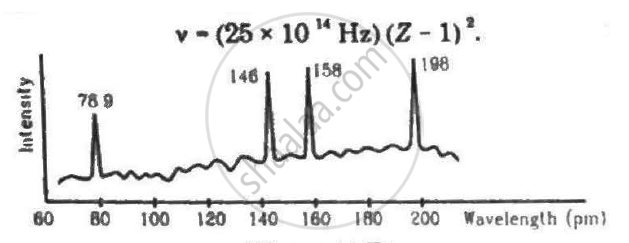
Continuous X-rays are made to strike a tissue paper soaked with polluted water. The incoming X-rays excite the atoms of the sample by knocking out the electrons from the inner shells. Characteristic X-rays are analysed and the intensity is plotted against the wavelength. Assuming that only Kα intensities are detected, list the elements present in the sample from the plot. Use Moseley's equation v − (25 × 1014Hz)(Z − 1)2.
(Use Planck constant h = 6.63 × 10⁻³⁴ Js= 4.14 × 10⁻¹⁵ eVs, speed of light c = 3 × 10⁸ m/s.)
Two waves A and B have wavelength 0.01 Å and 9000 Å respectively.
Name the two waves. compare the speeds of these waves when they travel in vacuum.
Name the part of the electromagnetic spectrum which is:
Produced by bombarding a metal target with high electrons.
Name the radiation of the electromagnetic spectrum which is used for the following:
To photograph internal parts of the human body and Give the frequency range
Name two sources of infrared radiation.
State three properties of ultra-violet radiation similar to visible light.
An e.m. wave exerts pressure on the surface on which it is incident. Justify.
A bat moving at 10 ms−1 towards a wall sends a sound signal of 8000 Hz towards it. On reflection, it hears a sound of frequency f The value of f in Hz is close to (speed of sound = 320 ms−1)
A car is moving towards a high cliff. The car driver sounds a horn of frequency f. The reflected sound heard by the driver has a frequency 2f. If v be the velocity of sound, then the velocity of the car, in the same velocity units, will be:
The half-value thickness of an absorber is defined as the thickness that will reduce exponentially the intensity of a beam of particles by a factor of 2. The half-value thickness in (µm) for lead assuming X-ray beam of wavelength 20 pm, µ = 50 cm-1 for X-rays in lead at wavelength λ = 20 pm, is ______ µm.
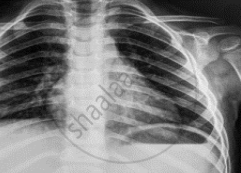
Name the electromagnetic radiation that has been used in obtaining the image below.
Which part of the electromagnetic spectrum can the human eye detect?
