Advertisements
Advertisements
Question
The Kα and Kβ X-rays of molybdenum have wavelengths 0.71 A and 0.63 A respectively. Find the wavelength of Lα X-ray of molybdenum.
Advertisements
Solution
Given :
Wavelength of Kα X-rays, `lambda_1`= 0.71 A
Wavelength of Kβ X-rays, `lambda_2` = 0.63 A
For La X-ray of molybdenum,
a = 57
b = 1
From Moseley's equation,
`sqrt(v) = a(Z - b)`
Here, v = frequency of X-ray
Z = atomic number of the element
`sqrt(v) = a(Z - b)`
⇒ `sqrt(v) = a(57 - 1)`
= `a xx 56` ...(1)
For `Cu` (29),
`sqrt(1.88 xx 10^18) = a(29 - 1) = 28 a ...(2)`
Dividing (1) and (2)
`sqrt(v/(1.88 xx 10^18)) = (a xx 56)/(a xx 28) = 2`
⇒ `v = 1.88 xx 10^18 xx (2)^2`
= `4 xx 1.88 xx 10^18`
= `7.52 xx 10^18 "Hz"`
APPEARS IN
RELATED QUESTIONS
The terminology of different parts of the electromagnetic spectrum is given in the text. Use the formula E = hv (for energy of a quantum of radiation: photon) and obtain the photon energy in units of eV for different parts of the electromagnetic spectrum. In what way are the different scales of photon energies that you obtain related to the sources of electromagnetic radiation?
Name the waves produced by the changes in the nucleus of an atom.
Is it possible that in a Coolidge tube characteristic Lα X-rays are emitted but not Kα X-rays?
Visible light passing through a circular hole forms a diffraction disc of radius 0.1 mm on a screen. If an X-ray is passed through the same setup, the radius of the diffraction disc will be
The Kα X-rays of aluminium (Z = 13) and zinc (Z = 30) have wavelengths 887 pm and 146 pm respectively. Use Moseley's law √v = a(Z − b) to find the wavelengths of the Kα X-ray of iron (Z = 26).
(Use Planck constant h = 6.63 × 10⁻³⁴ Js= 4.14 × 10⁻¹⁵ eVs, speed of light c = 3 × 10⁸ m/s.)
An X-ray tube operates at 40 kV. Suppose the electron converts 70% of its energy into a photon at each collision. Find the lowest there wavelengths emitted from the tube. Neglect the energy imparted to the atom with which the electron collides.
(Use Planck constant h = 6.63 × 10⁻³⁴ Js= 4.14 × 10⁻¹⁵ eVs, speed of light c = 3 × 10⁸ m/s.)
The stopping potential in a photoelectric experiment is linearly related to the inverse of the wavelength (1/λ) of the light falling on the cathode. The potential difference applied across an X-ray tube is linearly related to the inverse of the cutoff wavelength (1/λ) of the X-ray emitted. Show that the slopes of the lines in the two cases are equal and find its value.
(Use Planck constant h = 6.63 × 10⁻³⁴ Js= 4.14 × 10⁻¹⁵ eVs, speed of light c = 3 × 10⁸ m/s.)
Suppose a monochromatic X-ray beam of wavelength 100 pm is sent through a Young's double slit and the interference pattern is observed on a photographic plate placed 40 cm away from the slit. What should be the separation between the slits so that the successive maxima on the screen are separated by a distance of 0.1 mm?
Arrange the following electromagnetic waves in increasing order of their frequencies (i.e. begin with the lowest frequency):
Visible light, y rays, X rays, microwaves, radio waves, infrared radiations, and ultraviolet radiation.
Answer briefly.
Does an ordinary electric lamp emit EM waves?
Solve the numerical problem.
Calculate the frequency in MHz of a radio wave of wavelength 250 m. Remember that the speed of all EM waves in a vacuum is 3.0 × 10⁸ m/s.
All components of the electromagnetic spectrum in a vacuum have the same ______
Give any two uses of infrared waves.
Choose the correct option related to wavelengths (λ) of different parts of the electromagnetic spectrum.
Below is an incomplete table showing the arrangement of electromagnetic spectrum in the increasing order of their wavelength. Complete the table:
| Gamma ray | X - ray | UV rays | Visible rays | Infrared | A | Radio waves |
- Identify the radiation A.
- Name the radiation used to detect fracture in bones.
- Name one property common to both A and Radio waves.
Name one radiation having the wavelength longer than the wavelength of these radiations.
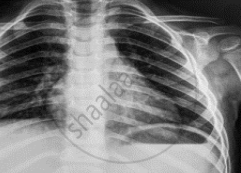
Name the electromagnetic radiation that has been used in obtaining the image below.
In an atom X, electrons absorb the energy from an external source. This energy “excites” the electrons from a lower-energy level to a higher-energy level around the nucleus of the atom. When electrons return to the ground state, they emit photons.
The figure below is the energy level diagram of atom X with three energy levels, E1 = 0.00eV, E2 = 1.78eV and E3 = 2.95eV. The ground state is considered 0 eV for reference. The transition of electrons takes place between levels E1 and E2.

- What wavelength of radiation is needed to excite the atom to energy level E2 from E1?
- Suppose the external source has a power of 100 W. What would be the rate of photon emission?
