Advertisements
Advertisements
Question
If the potential difference applied to the tube is doubled and the separation between the filament and the target is also doubled, the cutoff wavelength
Options
will remain unchanged
will be doubled
will be halved
will become four times the original
Advertisements
Solution
will be halved
Cut off wavelength is given by `lambda_min = (hc)/(eV)`,
where h = Planck's constant
c = speed of light
e = charge on an electron
V = potential difference applied to the tube
When potential difference (V) applied to the tube is doubled, cutoff wavelength (`lambda'_min`) is given by
`lambda'_min` = `(hc)/(e(2V)`
⇒ `lambda'_min = lambda_min/2`
Cuttoff wavelength does not depend on the separation between the filament and the target.
Thus, cutoff wavelength will be halved if the the potential difference applied to the tube is doubled.
APPEARS IN
RELATED QUESTIONS
The terminology of different parts of the electromagnetic spectrum is given in the text. Use the formula E = hv (for energy of a quantum of radiation: photon) and obtain the photon energy in units of eV for different parts of the electromagnetic spectrum. In what way are the different scales of photon energies that you obtain related to the sources of electromagnetic radiation?
Use the formula λm T= 0.29 cm K to obtain the characteristic temperature ranges for different parts of the electromagnetic spectrum. What do the numbers that you obtain tell you?
A wave has wavelength 50 Å.
- Name the wave.
- State its speed in vacuum.
- State its one use.
Name the electromagnetic radiations used for (a) water purification, and (b) eye surgery.
What do you understand by the statement, "Electromagnetic waves transport momentum"?
What is the range of the wavelength of the following electromagnetic waves?
(a) Infrared.
Give the range of wavelength of the electromagnetic waves visible to us.
How are X-rays produced?
When a Coolidge tube is operated for some time it becomes hot. Where does the heat come from?
Is it possible that in a Coolidge tube characteristic Lα X-rays are emitted but not Kα X-rays?
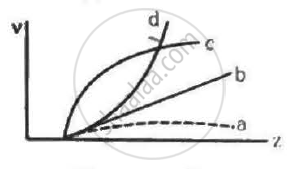
Frequencies of Kα X-rays of different materials are measured. Which one of the graphs in the figure may represent the relation between the frequency v and the atomic number Z ?
The electric current in an X-ray tube (from the target to the filament) operating at 40 kV is 10 mA. Assume that on an average, 1% of the total kinetic energy of the electron hitting hte target are converted into X-rays.
(a) What is the total power emitted as X-rays and (b) how much heat is produced in the target every second?
| Gamma rays | D | C | Visible light | B | A |
The above table shows different parts of the electromagnetic spectrum.
(a) Identify the parts of the spectrum marked as A, B, C and D.
(b) Which of the radiations A or B has the higher frequency?
(c) State two properties which are common to all parts of the electromagnetic spectrum.
(d) Name one source of each of the radiation of electromagnetic spectrum.
(e) Name one detector for each of the radiation.
(f) Name one use of each of the radiation.
Calculate the shortest wavelength of electromagnetic radiation present in Balmer series of hydrogen spectrum.
Name the radiations used for the detection of fracture in bones.
Solve the numerical problem.
Calculate the wavelength in nm of an X-ray wave of frequency 2.0 × 10¹⁸ Hz.
X-rays, gamma rays and microwaves travelling in a vacuum have ______.
Which of the following is a tool used for separating the different color wavelengths from each other?
The electric field intensity produced by the radiations coming from 100 W bulb at a 3 m distance is E. The electric field intensity produced by the radiations coming from 50 W bulb at the same distance is ______.
At what speed do all electromagnetic waves travel in a vacuum?
