Advertisements
Advertisements
प्रश्न
If the potential difference applied to the tube is doubled and the separation between the filament and the target is also doubled, the cutoff wavelength
विकल्प
will remain unchanged
will be doubled
will be halved
will become four times the original
Advertisements
उत्तर
will be halved
Cut off wavelength is given by `lambda_min = (hc)/(eV)`,
where h = Planck's constant
c = speed of light
e = charge on an electron
V = potential difference applied to the tube
When potential difference (V) applied to the tube is doubled, cutoff wavelength (`lambda'_min`) is given by
`lambda'_min` = `(hc)/(e(2V)`
⇒ `lambda'_min = lambda_min/2`
Cuttoff wavelength does not depend on the separation between the filament and the target.
Thus, cutoff wavelength will be halved if the the potential difference applied to the tube is doubled.
APPEARS IN
संबंधित प्रश्न
The terminology of different parts of the electromagnetic spectrum is given in the text. Use the formula E = hv (for energy of a quantum of radiation: photon) and obtain the photon energy in units of eV for different parts of the electromagnetic spectrum. In what way are the different scales of photon energies that you obtain related to the sources of electromagnetic radiation?
The small ozone layer on top of the stratosphere is crucial for human survival. Why?
Name the high energetic invisible electromagnetic waves which help in the study of the structure of crystals
What is the range of the wavelength of the following electromagnetic waves?
(a) Gamma rays.
Name the waves of wavelength nearly 0.1 nm.
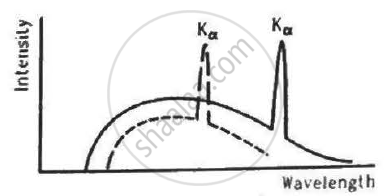
The figure shows the intensity-wavelength relations of X-rays coming from two different Coolidge tubes. The solid curve represents the relation for the tube A in which the potential difference between the target and the filament is VA and the atomic number of the target material is ZA. These quantities are VB and ZB for the other tube. Then,
50% of the X-ray coming from a Coolidge tube is able to pass through a 0.1 mm thick aluminium foil. The potential difference between the target and the filament is increased. The thickness of the aluminium foil that will allow 50% of the X-ray to pass through will be
Name the scientist who discovered
X-rays
How will you investigate the existence of the radiation beyond the red and violet extremes of the spectrum?
Choose the correct option.
The EM wave emitted by the Sun and responsible for heating the Earth’s atmosphere due to greenhouse effect is
Answer briefly.
What are radio waves?
Solve the numerical problem.
The speed of light is 3 × 10⁸ m/s. Calculate the frequency of red light of a wavelength of 6.5 × 10⁻⁷ m.
If the Earth did not have atmosphere, would its average surface temperature be higher or lower than what it is now? Explain.
An electron beam is accelerated by a potential difference V to hit a metallic target to produce X-rays. It produces continuous as well as characteristic X-rays. If λmin is the smallest possible wavelength of X-ray in the spectrum, the variation of log λmin with log V is correctly represented in:
The frequency of e. m waves which is best suited .to observed of radius 3 × 10⁻⁴ his of the order of
Give any two uses of infrared waves.
What is called the invisible spectrum?
Which relation connects the speed of light in vacuum, frequency, and wavelength?
How do the wavelengths and frequencies of microwaves compare with those of radio waves?
Which are uses of gamma rays?
