Advertisements
Advertisements
प्रश्न
Answer briefly.
What are radio waves?
Advertisements
उत्तर
- Radio waves are produced by accelerated motion of charges in a conducting wire. The frequency of waves produced by the circuit depends upon the magnitudes of the inductance and the capacitance.
- Thus, by choosing suitable values of the inductance and the capacitance, radio waves of the desired frequency can be produced.
APPEARS IN
संबंधित प्रश्न
A radio can tune in to any station in the 7.5 MHz to 12 MHz band. What is the corresponding wavelength band?
Name the high energetic invisible electromagnetic waves which help in the study of the structure of crystals
A wave has wavelength 50 Å.
- Name the wave.
- State its speed in vacuum.
- State its one use.
What is the range of the wavelength of the following electromagnetic waves?
(a) Infrared.
Give the range of wavelength of the electromagnetic waves visible to us.
Name the rays or waves of highest frequency .
Two waves A and B have wavelength 0.01 Å and 9000 Å respectively.
- Name the two waves.
- Compare the speeds of these waves when they travel in vacuum.
Can X-rays be polarised?
Consider a photon of a continuous X-ray coming from a Coolidge tube. Its energy comes from
Mark the correct options.
(a) An atom with a vacancy has smaller energy that a neutral atom.
(b) K X-ray is emitted when a hole makes a jump from the K shell to some other shell.
(c) The wavelength of K X-ray is smaller than the wavelength of L X-ray of the same material.
(d) The wavelength of Kα X-ray is smaller than the wavelength of Kβ X-ray of the same material.
Write the range of the wavelength of the following electromagnetic radiations:
(a) Infrared rays
(b) Ultraviolet rays
(c) γ -rays
Write one use of each of the above.
Gamma rays and radio waves travel with the same velocity in free space. Distinguish between them in terms of their origin and the main application.
How will you investigate the existence of the radiation beyond the red and violet extremes of the spectrum?
What is the wavelength of the wave whose frequency is 1012 Hz? Name the electromagnetic wave.
Choose the correct option.
How does the frequency of a beam of ultraviolet light change when it travels from air into glass?
Solve the numerical problem.
The speed of light is 3 × 10⁸ m/s. Calculate the frequency of red light of a wavelength of 6.5 × 10⁻⁷ m.
One requires 11eV of energy to dissociate a carbon monoxide molecule into carbon and oxygen atoms. The minimum frequency of the appropriate electromagnetic radiation to achieve the dissociation lies in ______.
Electromagnetic waves with wavelength
- λ1 is used in satellite communication.
- λ2 is used to kill germs in water purifies.
- λ3 is used to detect leakage of oil in underground pipelines.
- λ4 is used to improve visibility in runways during fog and mist conditions.
- Identify and name the part of electromagnetic spectrum to which these radiations belong.
- Arrange these wavelengths in ascending order of their magnitude.
- Write one more application of each.
Write two uses of the following radiation.
Gamma rays
Identify the part of the electromagnetic spectrum which:
- produces the heating effect.
- is absorbed by the ozone layer in the atmosphere.
- is used for studying crystal structure.
Write any one method of the production of each of the above radiations.
Name the electromagnetic radiation that has been used in obtaining the image below.
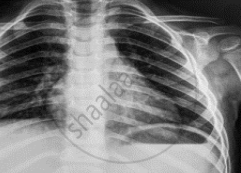
Which part of the electromagnetic spectrum is known as the visible spectrum?
In \[c = \nu\lambda\], what do \[c\], \[\nu\], and \[\lambda\] represent?
How do ultraviolet rays compare with visible light?
Which electromagnetic radiation has the highest frequency and shortest wavelength?
What gives rise to gamma rays?
