Advertisements
Advertisements
प्रश्न
If the current in the circuit for heating the filament is increased, the cutoff wavelength
विकल्प
will increase
will decrease
will remain unchanged
will change
Advertisements
उत्तर
will remain unchanged
Cut off wavelength is given by `lambda_min = (hc)/(eV)`,
where h = Planck's constant
c = speed of light
e = charge on an electron
V = potential difference applied to the tube
Clearly, the cutoff wavelength does not depend on the current in the circuit and temperature of the filament.
APPEARS IN
संबंधित प्रश्न
To which part of electromagnetic spectrum does a wave of frequency 3 × 10¹³ Hz belong?
To which part of the electromagnetic spectrum does a wave of frequency 5 × 10¹¹ Hz belong?
Why are infra-red waves often called heat waves? Explain.
X-ray and visible light travel at the same speed in vacuum. Do they travel at the same speed in glass?
50% of the X-rays coming from a Coolidge tube are able to pass through a 0.1 mm thick aluminium foil. If the potential difference between the target and the filament is increased, the fraction of the X-rays passing through the same foil will be
Find the energy, the frequency and the momentum of an X-ray photon of wavelength 0.10 nm.
(Use Planck constant h = 4.14 × 10⁻¹⁵ eVs, speed of light c = 3 × 10⁸ m/s.)
The electric current in an X-ray tube (from the target to the filament) operating at 40 kV is 10 mA. Assume that on an average, 1% of the total kinetic energy of the electron hitting hte target are converted into X-rays.
(a) What is the total power emitted as X-rays and (b) how much heat is produced in the target every second?
The wavelengths of Kα and Lα X-rays of a material are 21.3 pm and 141 pm respectively. Find the wavelength of Kβ X-ray of the material.
(Use Planck constant h = 6.63 × 10⁻³⁴ Js= 4.14 × 10⁻¹⁵ eVs, speed of light c = 3 × 10⁸ m/s.)
The electron beam in a colour TV is accelerated through 32 kV and then strikes the screen. What is the wavelength of the most energetic X-ray photon?
(Use Planck constant h = 6.63 × 10⁻³⁴ Js= 4.14 × 10⁻¹⁵ eVs, speed of light c = 3 × 10⁸ m/s.)
Suppose a monochromatic X-ray beam of wavelength 100 pm is sent through a Young's double slit and the interference pattern is observed on a photographic plate placed 40 cm away from the slit. What should be the separation between the slits so that the successive maxima on the screen are separated by a distance of 0.1 mm?
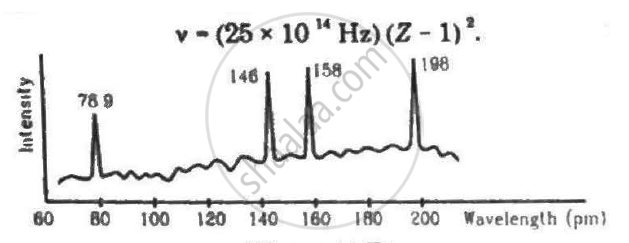
Continuous X-rays are made to strike a tissue paper soaked with polluted water. The incoming X-rays excite the atoms of the sample by knocking out the electrons from the inner shells. Characteristic X-rays are analysed and the intensity is plotted against the wavelength. Assuming that only Kα intensities are detected, list the elements present in the sample from the plot. Use Moseley's equation v − (25 × 1014Hz)(Z − 1)2.
(Use Planck constant h = 6.63 × 10⁻³⁴ Js= 4.14 × 10⁻¹⁵ eVs, speed of light c = 3 × 10⁸ m/s.)
State the name and the range of wavelength of the invisible electromagnetic waves beyond the red end of the visible spectrum.
Name three radiations and their wavelength range which are invisible and beyond the violet end of the visible spectrum.
Name the part of the electromagnetic spectrum which is:
Suitable for radar systems used in aircraft navigation.
Give one use of electromagnetic radiation in Ultraviolet radiation.
Answer briefly.
Give two uses of radio waves.
Photons of an electromagnetic radiation has an energy 11 keV each. To which region of electromagnetic spectrum does it belong?
What happens to wavelength as the frequency of electromagnetic radiation increases?
Which relation connects the speed of light in vacuum, frequency, and wavelength?
Which set lists applications of X-rays?
