Advertisements
Advertisements
प्रश्न
Answer briefly.
Why light waves travel in a vacuum whereas sound waves cannot?
Advertisements
उत्तर
Light waves are electromagnetic waves that can travel in a vacuum where sound waves travel due to the vibration of particles of the medium. Without any particles present (like in a vacuum) no vibrations can be produced. Hence, the sound wave cannot travel through the vacuum.
APPEARS IN
संबंधित प्रश्न
Name the waves used for taking photographs in dark.
Name two sources, each of infrared radiations and ultraviolet radiations.
Name of physical quantity which remains same for microwaves of wavelength 1 mm and UV radiations of 1600 Å in vacuum.
When a Coolidge tube is operated for some time it becomes hot. Where does the heat come from?
Characteristic X-rays may be used to identify the element from which they are being emitted. Can continuous X-rays be used for this purpose?
Can Lα X-ray of one material have shorter wavelength than Kα X-ray of another?
An X-ray beam can be deflected
If the potential difference applied to the tube is doubled and the separation between the filament and the target is also doubled, the cutoff wavelength
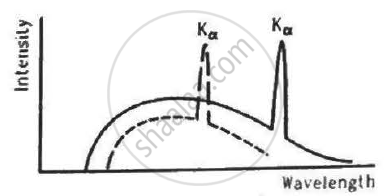
The figure shows the intensity-wavelength relations of X-rays coming from two different Coolidge tubes. The solid curve represents the relation for the tube A in which the potential difference between the target and the filament is VA and the atomic number of the target material is ZA. These quantities are VB and ZB for the other tube. Then,
Iron emits Kα X-ray of energy 6.4 keV. Calculate the times taken by an iron Kα photon to cross through a distance of 3 km.
(Use Planck constant h = 4.14 × 10⁻¹⁵ eVs, speed of light c = 3 × 10⁸ m/s.)
The electric current in an X-ray tube (from the target to the filament) operating at 40 kV is 10 mA. Assume that on an average, 1% of the total kinetic energy of the electron hitting hte target are converted into X-rays.
(a) What is the total power emitted as X-rays and (b) how much heat is produced in the target every second?
Heat at the rate of 200 W is produced in an X-ray tube operating at 20 kV. Find the current in the circuit. Assume that only a small fraction of the kinetic energy of electrons is converted into X-rays.
The electron beam in a colour TV is accelerated through 32 kV and then strikes the screen. What is the wavelength of the most energetic X-ray photon?
(Use Planck constant h = 6.63 × 10⁻³⁴ Js= 4.14 × 10⁻¹⁵ eVs, speed of light c = 3 × 10⁸ m/s.)
An X-ray tube operates at 40 kV. Suppose the electron converts 70% of its energy into a photon at each collision. Find the lowest there wavelengths emitted from the tube. Neglect the energy imparted to the atom with which the electron collides.
(Use Planck constant h = 6.63 × 10⁻³⁴ Js= 4.14 × 10⁻¹⁵ eVs, speed of light c = 3 × 10⁸ m/s.)
Name two sources of infrared radiation.
State two uses of infrared radiations.
Name the e.m. waves which are suitable for radar systems used in aircraft navigation. Write the range of frequency of these waves.
A bat moving at 10 ms−1 towards a wall sends a sound signal of 8000 Hz towards it. On reflection, it hears a sound of frequency f The value of f in Hz is close to (speed of sound = 320 ms−1)
Which of the following is a tool used for separating the different color wavelengths from each other?
A radio can tune to any station in the 7.5 mHz to 12 MHz band. What is corresponding wave length band.
SONAR emits which of the following waves?
If λv, λx and λm Am represents the wavelength of visible light, x-ray and microwaves respectively, then ______.
Name the electromagnetic radiation whose frequency is 10 Hz.
What is the speed of radio waves in vacuum?
At what speed do all electromagnetic waves travel in a vacuum?
Which properties characterize X-rays?
