Advertisements
Advertisements
प्रश्न
The electron beam in a colour TV is accelerated through 32 kV and then strikes the screen. What is the wavelength of the most energetic X-ray photon?
(Use Planck constant h = 6.63 × 10⁻³⁴ Js= 4.14 × 10⁻¹⁵ eVs, speed of light c = 3 × 10⁸ m/s.)
Advertisements
उत्तर
Given:-
Potential of the electron beam, V = 32 kV = 32 × 103 V
`"Energy", E = 32 xx 10^3 "eV"`
Wavelength of the X-ray photon (`lambda`) is given by
`lambda = (hc)/E`
Here,
h = Planck's constant
c = Speed of light
`therefore lambda = (hc)/E`
`⇒ lambda = (1242 "eVnm")/(32 xx 10^3)`
`⇒ lambda = 38.8 xx 10^-3 "nm"`
`⇒ lambda = 38.8 "pm"`
APPEARS IN
संबंधित प्रश्न
To which part of the electromagnetic spectrum does a wave of frequency 5 × 10¹⁹ Hz belong?
A wave has a wavelength of 10-3 nm. Name the wave.
Name three properties of ultraviolet radiations which are similar to visible light.
Can X-rays be used for photoelectric effect?
Characteristic X-rays may be used to identify the element from which they are being emitted. Can continuous X-rays be used for this purpose?
Can Lα X-ray of one material have shorter wavelength than Kα X-ray of another?
Suppose a monochromatic X-ray beam of wavelength 100 pm is sent through a Young's double slit and the interference pattern is observed on a photographic plate placed 40 cm away from the slit. What should be the separation between the slits so that the successive maxima on the screen are separated by a distance of 0.1 mm?
Two waves A and B have wavelength 0.01 Å and 9000 Å respectively.
Name the two waves. compare the speeds of these waves when they travel in vacuum.
Name two sources of ultraviolet radiation.
Choose the correct option.
The EM wave emitted by the Sun and responsible for heating the Earth’s atmosphere due to greenhouse effect is
The frequency of x-rays, y-rays and ultraviolet rays are respectively a, b and c. Then:-
Why does microwave oven heats up a food item containing water molecules most efficiently?
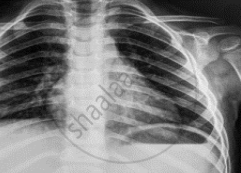
Name the electromagnetic radiation that has been used in obtaining the image below.
What do electromagnetic waves require for propagation?
Which relation connects the speed of light in vacuum, frequency, and wavelength?
Which radiation has the longest wavelength and lowest frequency in the electromagnetic spectrum?
Which devices commonly produce microwaves?
Why can a microwave oven heat food?
Where does infrared radiation lie relative to visible light?
Which properties characterize X-rays?
