Advertisements
Advertisements
प्रश्न
The short-wavelength limit shifts by 26 pm when the operating voltage in an X-ray tube is increased to 1.5 times the original value. What was the original value of the operating voltage?
(Use Planck constant h = 6.63 × 10⁻³⁴ Js= 4.14 × 10⁻¹⁵ eVs, speed of light c = 3 × 10⁸ m/s.)
Advertisements
उत्तर
Let `lambda` be the initial wavelength, V be the initial potential, `lambda^'`be the new wavelength and V' be the new operating voltage when the operating voltage is increased in the X-ray tube.
Given :-
`lambda^' = lambda - 26 "pm"`
V = 1.5 V
Energy (E) is given by
`E = (hc)/lambda`
`⇒ eV = (hc)/lambda`
Here,
h = Planck's constant
c = Speed of light
`lambda` = Wavelength of light
V = Operating potential
`therefore lambda = (hc)/(eV)`
`⇒ lambdaV = lambda^'V^' ............[∵ lambda ∝ 1/V]`
`⇒ lambda V = (lambda - 26) xx 1.5 V`
`⇒ 0.5lambda = 26 xx 1.5`
`⇒ lambda = 26 xx 3`
`⇒ lambda = 78 "pm"`
Hence, the initial wavelength is `78 xx 10^-12 "m".`
Now, the operating voltage (V) is given by
`V = (hc)/(elambda)`
`⇒ V = (6.63 xx 10^-34 xx 3 xx 10^8)/(1.6 xx 10^-19 xx 78 xx 10^-12)`
`⇒ V = 0.15937 xx 10^5`
`⇒ V = 15.9 "kV"`
APPEARS IN
संबंधित प्रश्न
(a) Give a list of at least five radiations, in order of their increasing frequencies, which make up the complete electromagnetic spectrum.
(b) Which of the radiation mentioned by you in part (a) has the highest penetrating power.
What is the range of the wavelength of the following electromagnetic waves?
(a) Visible.
What is the range of the wavelength of the following electromagnetic waves?
(a) Micro waves .
Give the range of wavelength of the electromagnetic waves visible to us.
Name the region beyond the violet end of the spectrum called.
State the approximate range of wavelength associated with infrared rays.
Name the rays or waves of highest frequency .
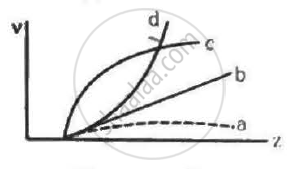
Frequencies of Kα X-rays of different materials are measured. Which one of the graphs in the figure may represent the relation between the frequency v and the atomic number Z ?
The electric current in an X-ray tube (from the target to the filament) operating at 40 kV is 10 mA. Assume that on an average, 1% of the total kinetic energy of the electron hitting hte target are converted into X-rays.
(a) What is the total power emitted as X-rays and (b) how much heat is produced in the target every second?
The energy of a silver atom with a vacancy in K shell is 25.31 keV, in L shell is 3.56 keV and in M shell is 0.530 keV higher than the energy of the atom with no vacancy. Find the frequency of Kα, Kβ and Lα X-rays of silver.
(Use Planck constant h = 6.63 × 10⁻³⁴ Js= 4.14 × 10⁻¹⁵ eVs, speed of light c = 3 × 10⁸ m/s.)
If the operating potential in an X-ray tube is increased by 1%, by what percentage does the cutoff wavelength decrease?
(Use Planck constant h = 6.63 × 10⁻³⁴ Js= 4.14 × 10⁻¹⁵ eVs, speed of light c = 3 × 10⁸ m/s.)
Solve the numerical problem.
The speed of light is 3 × 10⁸ m/s. Calculate the frequency of red light of a wavelength of 6.5 × 10⁻⁷ m.
Calculate the wavelength of a microwave of a frequency of 8.0 GHz.
Radio waves of constant amplitude can be generated with.
All components of the electromagnetic spectrum in a vacuum have the same ______
In uranium (Z = 92) the K absorption edge is 0.107 Å and the Kα line is 0.126 Å, and the wavelength of the L absorption edge is ______.
Name the electromagnetic radiation whose frequency is 10 Hz.
What is the wavelength range of electromagnetic radiation used in radio broadcast?
Which radiation has the longest wavelength and lowest frequency in the electromagnetic spectrum?
Which set lists uses of microwaves?
