Advertisements
Advertisements
प्रश्न
What happens to the intensity of light from a bulb if the distance from the bulb is doubled? As a laser beam travels across the length of a room, its intensity essentially remains constant. What geometrical characteristic of LASER beam is responsible for the constant intensity which is missing in the case of light from the bulb?
Advertisements
उत्तर
We know intensity of light from a point source I α 1/r2, r is the distance from point source.
As the distance is doubled, so the intensity becomes one-fourth the initial value. But in case of laser, it does not spread, so its intensity remain same.
Some geometrical characteristics of LASER beam which are responsible for the constant intensity is
- Unidirection
- Monochromatic
- Coherent light
- Highly collimated
These characteristics are missing in the case of normal light from the bulb.
APPEARS IN
संबंधित प्रश्न
If the earth did not have atmosphere, would its average surface temperature be higher or lower than what it is now? Explain.
A radio can tune in to any station in the 7.5 MHz to 12 MHz band. What is the corresponding wavelength band?
What is the range of the wavelength of the following electromagnetic waves?
(a) Gamma rays.
State the approximate range of wavelength associated with visible light.
Name of physical quantity which remains same for microwaves of wavelength 1 mm and UV radiations of 1600 Å in vacuum.
50% of the X-ray coming from a Coolidge tube is able to pass through a 0.1 mm thick aluminium foil. The potential difference between the target and the filament is increased. The thickness of the aluminium foil that will allow 50% of the X-ray to pass through will be
Iron emits Kα X-ray of energy 6.4 keV. Calculate the times taken by an iron Kα photon to cross through a distance of 3 km.
(Use Planck constant h = 4.14 × 10⁻¹⁵ eVs, speed of light c = 3 × 10⁸ m/s.)
A certain element emits Kα X-ray of energy 3.69 keV. Use the data from the previous problem to identify the element.
(Use Planck constant h = 6.63 × 10⁻³⁴ Js= 4.14 × 10⁻¹⁵ eVs, speed of light c = 3 × 10⁸ m/s.)
Name two sources of ultraviolet radiation.
Answer briefly.
Can we produce a pure electric or magnetic wave in space? Why?
Answer briefly.
Why high-frequency carrier waves are used for the transmission of audio signals?
Which of the following is a tool used for separating the different color wavelengths from each other?
Identify the electromagnetic wave whose wavelength range is from about 10-3 m to about 10-1 m. Write one use of this.
Name one radiation having the wavelength longer than the wavelength of these radiations.
Name the electromagnetic radiation that has been used in obtaining the image below.
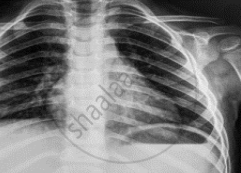
What is the wavelength range of electromagnetic radiation used in radio broadcast?
How do ultraviolet rays compare with visible light?
Which set lists uses of ultraviolet rays?
What can result from excess ultraviolet exposure?
Which set lists applications of X-rays?
