Advertisements
Advertisements
प्रश्न
Answer briefly.
What is a carrier wave?
Advertisements
उत्तर
The high-frequency waves on which the signals to be transmitted are superimposed are called carrier waves.
APPEARS IN
संबंधित प्रश्न
The terminology of different parts of the electromagnetic spectrum is given in the text. Use the formula E = hv (for energy of a quantum of radiation: photon) and obtain the photon energy in units of eV for different parts of the electromagnetic spectrum. In what way are the different scales of photon energies that you obtain related to the sources of electromagnetic radiation?
Optical and radio telescopes are built on the ground but X-ray astronomy is possible only from satellites orbiting the earth. Why?
(a) Give a list of at least five radiations, in order of their increasing frequencies, which make up the complete electromagnetic spectrum.
(b) Which of the radiation mentioned by you in part (a) has the highest penetrating power.
A wave has a wavelength of 10-3 nm. Name the wave.
Name the radiations of wavelength shorter than 4 × 10⁻⁷ m.
Name the rays or waves of highest frequency .
Two waves A and B have wavelength 0.01 Å and 9000 Å respectively.
- Name the two waves.
- Compare the speeds of these waves when they travel in vacuum.
X-ray and visible light travel at the same speed in vacuum. Do they travel at the same speed in glass?
The figure shows the intensity-wavelength relations of X-rays coming from two different Coolidge tubes. The solid curve represents the relation for the tube A in which the potential difference between the target and the filament is VA and the atomic number of the target material is ZA. These quantities are VB and ZB for the other tube. Then,
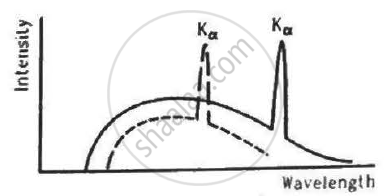
50% of the X-ray coming from a Coolidge tube is able to pass through a 0.1 mm thick aluminium foil. The potential difference between the target and the filament is increased. The thickness of the aluminium foil that will allow 50% of the X-ray to pass through will be
For harder X-rays,
(a) the wavelength is higher
(b) the intensity is higher
(c) the frequency is higher
(d) the photon energy is higher.
-
- Calculate the speed of the wave.
- Name the medium through which it is traveling.
Name the part of the electromagnetic spectrum which is:
Produced by bombarding a metal target with high electrons.
Name the radiation of the electromagnetic spectrum which is used for the following:
For taking photographs of the sky during the night and foggy conditions . Give the frequency range
Name two sources of ultraviolet radiation.
Give one use of electromagnetic radiation in Ultraviolet radiation.
State two uses of infrared radiations.
What are the ultraviolet rays?
Answer briefly.
Give two uses of radio waves.
Answer briefly.
Name the most harmful radiation entering the Earth's atmosphere from outer space.
Solve the numerical problem.
Calculate the wavelength in nm of an X-ray wave of frequency 2.0 × 10¹⁸ Hz.
X-rays, gamma rays and microwaves travelling in a vacuum have ______.
An electron beam is accelerated by a potential difference V to hit a metallic target to produce X-rays. It produces continuous as well as characteristic X-rays. If λmin is the smallest possible wavelength of X-ray in the spectrum, the variation of log λmin with log V is correctly represented in:
SONAR emits which of the following waves?
Identify the part of the electromagnetic spectrum which:
- produces the heating effect.
- is absorbed by the ozone layer in the atmosphere.
- is used for studying crystal structure.
Write any one method of the production of each of the above radiations.
Name one radiation having the wavelength longer than the wavelength of these radiations.
What is the nature of all electromagnetic waves?
How are the electric and magnetic fields oriented in an electromagnetic wave?
What happens to wavelength as the frequency of electromagnetic radiation increases?
How are X-rays commonly produced?
