Advertisements
Advertisements
प्रश्न
Answer briefly.
What is a carrier wave?
Advertisements
उत्तर
The high-frequency waves on which the signals to be transmitted are superimposed are called carrier waves.
APPEARS IN
संबंधित प्रश्न
What role dose infra-red radiation play in maintain the Earth’s warmth
Use the formula λm T= 0.29 cm K to obtain the characteristic temperature ranges for different parts of the electromagnetic spectrum. What do the numbers that you obtain tell you?
What is the range of the wavelength of the following electromagnetic waves?
(A) Radio waves.
Name two electromagnetic waves of frequency smaller than that of violet light. State one use of each.
An X-ray beam can be deflected
For harder X-rays,
(a) the wavelength is higher
(b) the intensity is higher
(c) the frequency is higher
(d) the photon energy is higher.
Mark the correct options.
(a) An atom with a vacancy has smaller energy that a neutral atom.
(b) K X-ray is emitted when a hole makes a jump from the K shell to some other shell.
(c) The wavelength of K X-ray is smaller than the wavelength of L X-ray of the same material.
(d) The wavelength of Kα X-ray is smaller than the wavelength of Kβ X-ray of the same material.
Heat at the rate of 200 W is produced in an X-ray tube operating at 20 kV. Find the current in the circuit. Assume that only a small fraction of the kinetic energy of electrons is converted into X-rays.
The short-wavelength limit shifts by 26 pm when the operating voltage in an X-ray tube is increased to 1.5 times the original value. What was the original value of the operating voltage?
(Use Planck constant h = 6.63 × 10⁻³⁴ Js= 4.14 × 10⁻¹⁵ eVs, speed of light c = 3 × 10⁸ m/s.)
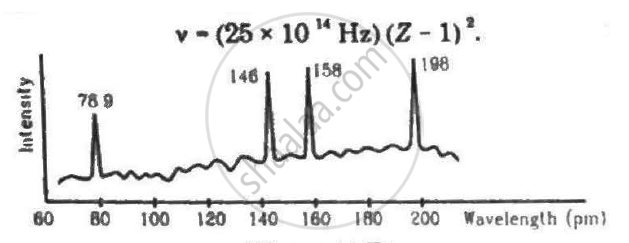
Continuous X-rays are made to strike a tissue paper soaked with polluted water. The incoming X-rays excite the atoms of the sample by knocking out the electrons from the inner shells. Characteristic X-rays are analysed and the intensity is plotted against the wavelength. Assuming that only Kα intensities are detected, list the elements present in the sample from the plot. Use Moseley's equation v − (25 × 1014Hz)(Z − 1)2.
(Use Planck constant h = 6.63 × 10⁻³⁴ Js= 4.14 × 10⁻¹⁵ eVs, speed of light c = 3 × 10⁸ m/s.)
Name the part of the electromagnetic spectrum which is:
Produced by bombarding a metal target with high electrons.
Name two sources of ultraviolet radiation.
Name the radiations used for the detection of fracture in bones.
Answer briefly.
Can we produce a pure electric or magnetic wave in space? Why?
Name the e.m. waves which are suitable for radar systems used in aircraft navigation. Write the range of frequency of these waves.
For television broadcasting, the frequency employed is normally
Following QN ∴ 14, the radiation force on the roof will be
The area to be covered for T.V telecast is doubled then the height of transmitting antenna (T.V tower) will have to be:-
SONAR emits which of the following waves?
Arrange the following electromagnetic radiation in the ascending order of their frequencies:
X-rays, microwaves, gamma rays, radio waves
Write two uses of the following radiation.
Gamma rays
Which one of the following electromagnetic radiation has the least wavelength?
Identify the electromagnetic wave whose wavelength range is from about 10-12 m to about 10-8 m. Write one use of this.
Identify the part of the electromagnetic spectrum which:
- produces the heating effect.
- is absorbed by the ozone layer in the atmosphere.
- is used for studying crystal structure.
Write any one method of the production of each of the above radiations.
What do electromagnetic waves require for propagation?
How do the wavelengths and frequencies of microwaves compare with those of radio waves?
Which devices commonly produce microwaves?
Which part of the electromagnetic spectrum can the human eye detect?
How are X-rays commonly produced?
