Advertisements
Advertisements
प्रश्न
Answer briefly.
Why high-frequency carrier waves are used for the transmission of audio signals?
Advertisements
उत्तर
An audio signal has a low frequency (< 20 kHz) and low-frequency signals cannot be transmitted over large distances. Because of this, high-frequency carrier waves are used for transmission.
APPEARS IN
संबंधित प्रश्न
Why are microwaves considered suitable for radar systems used in aircraft navigation?
To which part of electromagnetic spectrum does a wave of frequency 3 × 10¹³ Hz belong?
A wave has wavelength 50 Å.
- Name the wave.
- State its speed in vacuum.
- State its one use.
The wavelengths for the light of red and blue colours are roughly 7.8 × `10^7` m and 4.8 × `10^7` m respectively.
(a) Which colour has the greater speed in vacuum?
(b) Which colour has the greater speed in glass?
Which radiation is used for satellite communication?
What is the range of the wavelength of the following electromagnetic waves?
(a) Gamma rays.
Two waves A and B have wavelength 0.01 Å and 9000 Å respectively.
- Name the two waves.
- Compare the speeds of these waves when they travel in vacuum.
Name two sources, each of infrared radiations and ultraviolet radiations.
The wavelength of X-rays is 0.01 Å. Calculate its frequency. State the assumption made, if any.
In a Coolidge tube, electrons strike the target and stop inside it. Does the target get more and more negatively charged as time passes?
X-ray and visible light travel at the same speed in vacuum. Do they travel at the same speed in glass?
Consider a photon of a continuous X-ray coming from a Coolidge tube. Its energy comes from
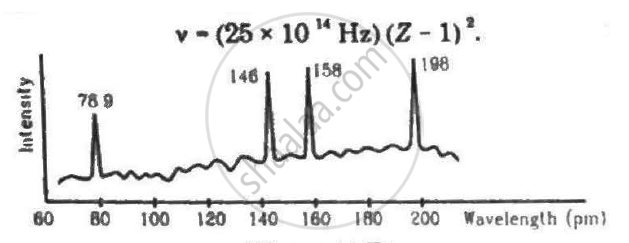
Continuous X-rays are made to strike a tissue paper soaked with polluted water. The incoming X-rays excite the atoms of the sample by knocking out the electrons from the inner shells. Characteristic X-rays are analysed and the intensity is plotted against the wavelength. Assuming that only Kα intensities are detected, list the elements present in the sample from the plot. Use Moseley's equation v − (25 × 1014Hz)(Z − 1)2.
(Use Planck constant h = 6.63 × 10⁻³⁴ Js= 4.14 × 10⁻¹⁵ eVs, speed of light c = 3 × 10⁸ m/s.)
Name the scientist who discovered Visible light
Identify the part of the electromagnetic spectrum used in
(i) radar and
(ii) eye surgery. Write their frequency range.
How will you investigate the existence of the radiation beyond the red and violet extremes of the spectrum?
Name two sources of ultraviolet radiation.
Give one use of electromagnetic radiation in Microwaves.
Choose the correct option.
Earth’s atmosphere is richest in
Answer briefly.
What is a carrier wave?
An e.m. wave exerts pressure on the surface on which it is incident. Justify.
Which of the following is a tool used for separating the different color wavelengths from each other?
What happens to the intensity of light from a bulb if the distance from the bulb is doubled? As a laser beam travels across the length of a room, its intensity essentially remains constant. What geometrical characteristic of LASER beam is responsible for the constant intensity which is missing in the case of light from the bulb?
Electromagnetic waves of wavelengths λ1, λ2 and λ3 are used in a radar system, in water purifiers and in remote switches of TV, respectively.
- Identify the electromagnetic waves.
- Write one source for each of them.
Identify the electromagnetic wave whose wavelength range is from about 10-12 m to about 10-8 m. Write one use of this.
Identify the part of the electromagnetic spectrum which:
- produces the heating effect.
- is absorbed by the ozone layer in the atmosphere.
- is used for studying crystal structure.
Write any one method of the production of each of the above radiations.
What is the nature of all electromagnetic waves?
Which description identifies how radio waves are mainly produced?
Which set consists of applications of infrared radiation?
Which properties characterize X-rays?
