Advertisements
Advertisements
Question
Name the radiations of wavelength just shorter than 4 × 10⁻⁷ m.
Advertisements
Solution
Ultraviolet radiations are shorter than 4 × 10⁻⁷ m = `(4 xx 10^-7)/(10^-10) = 4000` Å
APPEARS IN
RELATED QUESTIONS
What is the range of the wavelength of the following electromagnetic waves?
(a) Infrared.
Iron emits Kα X-ray of energy 6.4 keV. Calculate the times taken by an iron Kα photon to cross through a distance of 3 km.
(Use Planck constant h = 4.14 × 10⁻¹⁵ eVs, speed of light c = 3 × 10⁸ m/s.)
An X-ray tube operates at 40 kV. Suppose the electron converts 70% of its energy into a photon at each collision. Find the lowest there wavelengths emitted from the tube. Neglect the energy imparted to the atom with which the electron collides.
(Use Planck constant h = 6.63 × 10⁻³⁴ Js= 4.14 × 10⁻¹⁵ eVs, speed of light c = 3 × 10⁸ m/s.)
Write the range of the wavelength of the following electromagnetic radiations:
(a) Infrared rays
(b) Ultraviolet rays
(c) γ -rays
Write one use of each of the above.
A bat moving at 10 ms−1 towards a wall sends a sound signal of 8000 Hz towards it. On reflection, it hears a sound of frequency f The value of f in Hz is close to (speed of sound = 320 ms−1)
Below is an incomplete table showing the arrangement of electromagnetic spectrum in the increasing order of their wavelength. Complete the table:
| Gamma ray | X - ray | UV rays | Visible rays | Infrared | A | Radio waves |
- Identify the radiation A.
- Name the radiation used to detect fracture in bones.
- Name one property common to both A and Radio waves.
Name the electromagnetic radiation whose frequency is 10 Hz.
Name one radiation having the wavelength longer than the wavelength of these radiations.
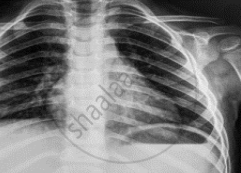
Name the electromagnetic radiation that has been used in obtaining the image below.
What is the wavelength range of electromagnetic radiation used in radio broadcast?
