Advertisements
Advertisements
प्रश्न
The stopping potential in a photoelectric experiment is linearly related to the inverse of the wavelength (1/λ) of the light falling on the cathode. The potential difference applied across an X-ray tube is linearly related to the inverse of the cutoff wavelength (1/λ) of the X-ray emitted. Show that the slopes of the lines in the two cases are equal and find its value.
(Use Planck constant h = 6.63 × 10⁻³⁴ Js= 4.14 × 10⁻¹⁵ eVs, speed of light c = 3 × 10⁸ m/s.)
Advertisements
उत्तर
V0 - Stopping Potential
K - Potential difference across X-ray tube
λ - Wavelength
λ - Cut difference Wavelength
`eV_0 = hf - hf_0`
`lambda = (hc)/(eV)`
`eV_0 = (hc)/lambda`
or ` Vlambda = (hc)/e`
or `V_0lambda = (hc)/e`
Here, the slopes are same.
i.e. V0λ = Vλ
`(hc)/e = (6.63 xx 10^-34 xx 3 xx 10^8)/(1.6 xx 10^-19)`
= `1.242 xx 10^-6 "Vm"`
APPEARS IN
संबंधित प्रश्न
The wavelengths for the light of red and blue colours are roughly 7.8 × `10^7` m and 4.8 × `10^7` m respectively.
(a) Which colour has the greater speed in vacuum?
(b) Which colour has the greater speed in glass?
Which radiation is used for satellite communication?
Give the range of wavelength of the electromagnetic waves visible to us.
Name the region beyond the red end of the spectrum.
What are ultraviolet radiations?
Can X-rays be polarised?
If the current in the circuit for heating the filament is increased, the cutoff wavelength
50% of the X-rays coming from a Coolidge tube are able to pass through a 0.1 mm thick aluminium foil. If the potential difference between the target and the filament is increased, the fraction of the X-rays passing through the same foil will be
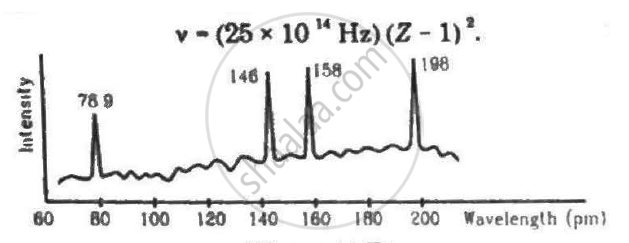
Continuous X-rays are made to strike a tissue paper soaked with polluted water. The incoming X-rays excite the atoms of the sample by knocking out the electrons from the inner shells. Characteristic X-rays are analysed and the intensity is plotted against the wavelength. Assuming that only Kα intensities are detected, list the elements present in the sample from the plot. Use Moseley's equation v − (25 × 1014Hz)(Z − 1)2.
(Use Planck constant h = 6.63 × 10⁻³⁴ Js= 4.14 × 10⁻¹⁵ eVs, speed of light c = 3 × 10⁸ m/s.)
Arrange the following electromagnetic waves in increasing order of their frequencies (i.e. begin with the lowest frequency):
Visible light, y rays, X rays, microwaves, radio waves, infrared radiations, and ultraviolet radiation.
Gamma rays and radio waves travel with the same velocity in free space. Distinguish between them in terms of their origin and the main application.
Choose the correct option.
How does the frequency of a beam of ultraviolet light change when it travels from air into glass?
Answer briefly.
What are radio waves?
Name the electromagnetic radiation whose frequency is 10 Hz.
At what speed do all electromagnetic waves travel in a vacuum?
Which radiation has the longest wavelength and lowest frequency in the electromagnetic spectrum?
How do the wavelengths and frequencies of microwaves compare with those of radio waves?
Which devices commonly produce microwaves?
How are X-rays commonly produced?
